As we come to St. Patrick’s Day, it’s good to remember that it’s not easy being green. Especially when you’re constantly compared to one of the most heinous villains of witch-kind: the Wicked Witch of the West. So let’s start with the OG witch. The big baddy of Oz.
The Wicked Witch of the West
The infamous witch of the original Wizard of Oz, specifically the 1939 movie adaptation, is one of the most devious and evil villains. The movie was released only two years after the Evil Queen appeared in Snow White.
While the Evil Queen was fueled by vanity, I think it’s safe to say that the Wicked Witch wasn’t concerned with vanity, simply power. She’s known for being petty, vile, and volatile. At least as far as the movie is concerned, her identity is based in the obsessive need to have Dorothy’s slippers. That's what makes her such an iconic villain, even decades later. And that has impacted our view of this green-skinned woman ever since.
Zelena (Once Upon a Time)
This iteration of the Wicked Witch came onto the scene as the residents of Storybrooke returned to the Enchanted Forest. With their cursed memories available, Snow, Regina, and everyone else immediately equated Zelena with the Witch from the movie.
And that’s kind of how Zelena was raised in Oz. Because of her magic, her adopted father considered her some wicked curse. When she learned about her half sister and turned green with envy, her appearance only reinforced that belief to the people of Oz. You call someone wicked long enough and they’ll believe that’s all she is. In fact, she began to equate herself with wickedness. “Wicked always wins” may have been her mantra, but that line is filled with shame. It wasn’t until she was treated with love from her mother and her sister that she began to see herself as something other than “wicked”.
Elfaba (Wicked)
Going into the Broadway play, we're meant to compare Elfaba to the original Wicked Witch. Like Zelena, she was treated as a villain because of her magical abilities. Unlike Zelena, Elfaba kept to her values and her priorities in a version of Oz that was full of discriminatory propaganda. Because she wouldn't play the Wizard's game, Elfaba was villainized.
It would have been easy for Elfaba to take on that baggage, like Zelena, and believe she was "wicked". Instead, she was sure enough of herself to be able to recognize the darkness of the world she lived in and rise above it. There are a lot of possible interpretations of "Defying Gravity" and this is one of them. We live in a fallen world and it can be easy to take on who the world says we are. It takes a lot of internal strength to remain a person of integrity when everyone around says to conform. Elfaba literally rose above her haters. She may not have changed Oz, but her influence changed Glinda and Fiyero "for good".
Growing up, I recall watching the film version of “Oklahoma” a number of times. I have thought recently about a song from this musical titled, “The Farmer and the Cowman should be Friends.” The application to our day is apparent to me in that it is a song about people from different walks of life learning to get along. Be it different political parties, teams we root for, religions, or ideas about which Star Trek captain is best, there are a lot of opinions to go around. But, to quote the aforementioned song, “that’s no reason why [we] can’t be friends.”
When I lived in Utah, there was often a letter shared in sacrament meeting around the time that elections were being held that I will paraphrase here: there is good to be found in all political parties.
I am a sports fan and while I am bummed when the team I root for loses, I can also appreciate the talent of players on the opposing team.
I am a member of the Church of Jesus Christ of Latter-day Saints and I admire the way that Muslims, Jews, Buddists, Protestants, Jehovah’s Witnesses, Catholics, and many others worship.
As for which Star Trek captain is best, I think I like them all in their own way. (Perhaps a bit too diplomatic, but I take that as my prerogative in authoring this post)
My point in writing these thoughts down is to encourage more dialogue and less dismissal. I know there are things I do not agree with others on but that does not mean I have to be disagreeable. I know how much I have been helped and continue to be helped by others. I know that I will continue to need help along my life’s journey.
I think Joseph Smith summed it up nicely in the following quote from 1843:
“The Saints can testify whether I am willing to lay down my life for my brethren. If it has been demonstrated that I have been willing to die for a ‘Mormon.’ I am bold to declare before Heaven that I am just as ready to die in defending the rights of a Presbyterian, a Baptist, or a good man of any other denomination; for the same principle which would trample upon the rights of the Latter-day Saints would trample upon the rights of the Roman Catholics, or of any other denomination who may be unpopular and too weak to defend themselves.”
I sure do hope this is helpful on some level. I saw an applicable lesson in this song from my childhood and wanted to both share the song and the message I thought could be found in it.
It's been a long time since the rumors of a Wicked movie began. Almost as far back as when I saw it with my brothers. We've had various iterations of Broadway musicals turned film, like Les Miserables, Hamilton, and Into the Woods. And now with the trailer released during the Super Bowl, it's almost time to see Elfaba and Glinda on the big screen. So in anticipation, I thought of six scenes/songs and what I'm looking forward to in the movie.
The Wizard and I
Specifically during this scene, I’m looking forward to seeing Elfaba’s vision of her “celebration”. I really hope they show us what she sees. But what will they show? We know from the Broadway play that she didn’t have all the pieces of the puzzle. But she did see herself happy. But it wasn’t the happy ending she’d expected. Maybe it was some inkling of being with Fiyero in the end? It’s a hazy, but they ought to show something right?
One Short Day
This song has so much stuff in it and it’s all supposed to be dazzling. What a spectacle this ought to be! From the palaces and museums to the horse of a different color (maybe), I want to be in awe just as much as Glinda and Elfie.
Defying Gravity
With how much this song has become a powerful anthem for many people, I can’t imagine this song will simply be Elfaba flying off on her broom. I’m not sure what I'm expecting here, but something amazing I guess.
As Long as You’re Mine
Mostly I’m curious how they’d go about shooting this scene. If it’s a romantic scene, it might look weird to have them singing to each other, though I suppose that’s what they do on stage. Instead, maybe the song could be playing over their scene, like “I See the Light” from Tangled?
No Good Deed
The special effects of this scene could be crazy! Never mind how this song really pulls at Elfaba’s heart as she chants. I’m curious what kind of effects they’ll use for her magic and if we’ll see Fiyero’s transformation. I could see them show him glowing like the Doctor regenerating or a Pokemon evolving? Or maybe some smokey magic like Once Upon a Time. But whatever they do for Fiyero, I’m looking forward to having my heart broken by the grief on Elfaba’s face.
For Good
Another iconic song, one that I knew long before seeing Wicked on stage. The emotion and love that goes into this song. Like “As Long as You’re Mine” this song could be performed between Elfaba and Glinda or it could be a voice-over like “I See the Light”. Really what I’m curious about in this scene is if they’ll give some indication as to where Fiyero and Elfaba go at the end. My head-canon for a while was (and still is kind of) that they went through a portal, like on Once Upon a Time. For a while I wondered if they were legitimately going to end up in Storybrooke (but Zelena appeared–maybe in another part of the multiverse).
And now we wait until Thanksgiving (and until Thanksgiving 2025 for the second half). Just remember to consider the Apple Pie Metaphor when seeing this movie, but I choose to withhold judgment until I've seen the movie itself. Not sure anything will measure up to Idina Menzel, but that's okay. I'll make a point of seeing it anyway.
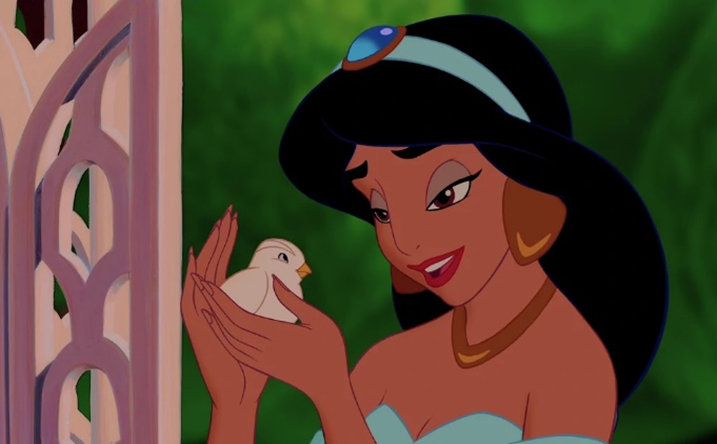
On November 25, 1992, “Aladdin,” Walt Disney Pictures’ 31st animated film premiered in theaters. Loving Disney feature animation, I was excited to see the newest addition to their canon. However, these feelings were tempered by the preconceived idea that I wouldn’t love it like “Beauty and the Beast” released the previous year. When I watched Aladdin on the big screen for the first time, I was immediately drawn in by the gorgeously detailed hand drawn and computer animation and the music by Alan Menken, Tim Rice, and the late Howard Ashman. Surprisingly the movie surpassed Beauty and the Beast in becoming my favorite Disney film. The moment was the appearance of the Sultan of Agrabah’s daughter, Princess Jasmine.
In the Princess’ introductory scene, I learned that she was being required to marry a man of the same social status by a predetermined date (Jasmine’s “next birthday”). In addition, the royal remained in the palace confines by her loving yet overprotective father. Like Belle, I quickly related to Jasmine. As a thirteen-year-old boy, I wasn’t royal, and marriage wasn’t even near the horizon. However, I began feeling the constraints of my parents’ rules. I was growing older and wanted to decide how to live my life.
Since my first encounter with her, I’ve been inspired by Jasmine’s characteristics exhibited in Aladdin and its adaptations to Broadway, television, and live-action film. In the original animated feature, I admire Jasmine’s independence. From the beginning, the princess is willing to utilize it and reject Prince Achmed as a potential husband. She is unafraid to vocalize to her father that she wants love to be the reason she marries and not because a law demands it or to satisfy the Sultan. Jasmine demonstrates her autonomy when she condemns Aladdin (disguised as Prince Ali), the Sultan, and Jafar for debating what’s best for her life. She states, “I am not a prize to be won!” When Aladdin offers the royal the chance to leave the palace via magic carpet, she willingly accepts. After Jafar takes over the kingdom, the deposed royal defies the evil new sovereign by refusing to bow and later rejects his offer to become his queen to end her enslavement. The most powerful moment where Jasmine exercises her independence is when the Sultan alters the marriage law to which she happily declares that Aladdin is her choice.
I like the observing and introspective nature Jasmine displays in the Broadway version of Aladdin. In her solo, the princess expresses frustration with specific demands of her royal station, especially the requirement to wed a man she doesn’t know or love. She knows that her suitors are only interested in her wealth. As the royal and her handmaidens sing about her situation, Jasmine recognizes that if she doesn’t listen to her heart and change course, she’ll end up bitter and unfeeling. This self-realization cements for the princess that she needs to leave the strict security of the palace and find what she is yearning for.
In the retelling of Aladdin in the television series Once Upon a Time, I love how Jasmine’s leadership is exhibited. Determined to end Jafar’s control over her father and Agrabah, the princess seeks out the mythical “diamond in the rough” which turns out to be Aladdin. When the evil sorcerer re-emerges as a threat after initially being stopped, Jasmine rejects the Sultan’s proposed plan for protection which would require her marrying a prince who possesses a military. Instead, she searches for Aladdin (who has disappeared) to enlist his help again. The royal is ready to make the sacrifice and willingly marry her people’s enemy when it appears her options have run out. Even though Jasmine faces setbacks, the princess perseveres. In doing so, Jafar is ultimately defeated and Agrabah is free and safe.
I’m affected by Jasmine’s self-advocacy in the Aladdin live-action remake. The possibility of succeeding her father as Agrabah’s ruler is questioned by Jasmine’s handmaiden, Dahlia, and dismissed by the Sultan and Jafar. This doesn’t stop Jasmine from expressing herself. The most dramatic moment of this is when Jafar usurps the throne. The princess powerfully persuades Hakim, the Captain of the Guard to continue supporting the rightful royal family. Through this demonstration and Jasmine’s subsequent willingness to stand up to their enemy, the Sultan realizes that his daughter is capable of reigning. He abdicates allowing the princess to become a female Sultan.
Since seeing Aladdin during the 1992 holiday season, the Princess of Agrabah has been and continues to be an inspiration. I had the unbelievable opportunity to meet her speaking voice, Linda Larkin and share how Jasmine has influenced my life. In honor of the 30th anniversary of Aladdin’s theatrical release, this post is dedicated to one of my most beloved Disney Princesses. Happy 30th Anniversary, Jasmine! Thanks to you, “I’m like a shooting star. I’ve come so far. I can’t go back to where I used to be!”
Music has a way of touching the soul like nothing else- and when woven into a narrative it can increase the impact till we can't stand it. The following are some songs from Broadway shows that bring yours truly to tears and leave me breathless.
For the record, I will NOT be including productions that started life as a film, so no Sister Act or Newsies, and no Disney productions so no Lion King or Beauty and the Beast. They deserve lists of their own.
Also, spoilers.
10: Memory (Cats)
This is one of the classic heartbreak songs of Broadway that even the awful Cats film couldn't ruin. The song is about remembering the time when things were better and Grizabella was young and beautiful. It invokes a sense of sadness at what she lost, and pared with the melodic tone it moves the heart every time.
9: Not My Father's Son (Kinky Boots)
This irreverent play is a celebration about being different, but being different comes with its own pain. This song is about not being able to live up to a father's expectations, despite wanting his approval. This is a pain most men go through, no matter their situation, so this becomes a dagger right to the daddy wound.
8: I'm Not That Girl (Wicked)
Usually the pick for Wicked is For Good, the finale and conclusion of Elphaba and Galinda's relationship, but I'm going to argue for I'm Not That Girl. Another song for the outcast, this is Elphaba morning the fact that she will never be the one Fiyero will ever want to be with (Even though he does later). It's a heartbreaking song about being rejected for things you can never change, whether you'd want to or not.
7: Little Fall of Rain (Les Miserables)
Honestly pick a song from this musical and you will probably burst into tears (Except Master of the House, that one's just pure fun) but I'm going with Little Fall of Rain. Here Epanine sacrifices herself to protect her beloved Marius, despite him being in love with Cozette. In her last words, she sings how all she wants is for him to be with her till the end, and that despite the sadness at least the rain will make the flowers grow, and thus something beautiful can come from this one moment.
6: For Forever (Dear Evan Hansen)
Quick synopsis: Evan is a shy depressed kid starting a new year at school with a broken arm. On the first day the school burnout swipes one of his letters he wrote for therapy then later that evening commits suicide. When the letter is found on him it's assumed that he and Evan were best friends. Evan, not wanting to tell grieving parents that the reason his letter was in their son's pocket was due to an act of bullying, decides to go with the assumption and procedes to make up a story about their friendship. Now if this show was purely a comedy (and a bad one at that) this story would probably be played up for laughs with exaggerations, things that can be easily misproven, and a lot of nervous stammering. Instead though Evan tells a story of them going out to the woods and climbing a tree when he fell off and subsequently broke his arm. The story is beautiful in the sincerity Evan pours into it, making the listener think that this was the day he wanted instead of the day he actually had, where he did go out to the woods and climb a tree but jumped off in his own suicide attempt. Evan rewrites his own story as a what if these boys had been friends, and what that friendship would've meant to each other.
5: Somewhere That's Green Reprise (Little Shop Of Horrors)
Somewhere That's Green is a pretty song in and of itself, as Audrey describes her want for a life outside the dirty city where everything is green and pretty. In the film that most people would be familiar with, Audrey and Seymore escape the flesh-eating plant and get their fairytale life. In the play however, Audrey is killed by Audrey II, and has a soliloquy about how she will become the green place she always wanted, as long as Seymore is there to take care of her they will always be together.
4: Doubt Comes In (Hadestown)
I talked about Hadestown recently but this song is probably the most killer (Get it, cause it's about death?) in it Orpheus and Euridice are trying to walk out of the underworld, their success based on weather or not Orpheus can lead them out without turning around to see if his beloved is still following him. The song is Orpheus in his head, debating weather or not Hades' promise is real and if Euridice is even still behind him. While Euridice is trying to encourage him, the music stings, indicating the moment when his doubt finally gets the better of him and he turns around. The moment is as heartbreaking now as when it was first penned thousands of years ago.
3: It's Quiet Uptown (Hamilton)
Another play where you can pretty much pick a song and cry, Hamilton's most tear-jerking song describes the grief parents feel after losing a child. Alexander wanders New York in a daze, his charisma completely eradicated by the loss of his son. On top of that we still have the fallout of the Reynold's pamphlet, where he confessed to infidelity on his wife. In this song though not only do we get their grief but her forgiveness, seeing a slight glimmer of hope in an extremely dark time.
2: You Are Not Alone (Into The Woods)
Even a comedy can have its moments, and the finale of Into the Woods is no exception. The baker, so scared to be a parent, holds his child and hears his wife's voice helping guide him in the first few moments of this new life. The entire idea that even when you feel alone that you aren't is something everyone at one point or another needs to hear, and this song takes us right back to those moments.
1: I'll Cover You Reprise (Rent)
This list has covered loss a lot (And a lot of reprises) but this funeral hymn takes the cake. Originally sung as a celebration of Angel and Collin's love, Collins now sings it at Angel's funeral, both celebrating and mourning his partner. The upbeat lyrics juxtoposed to Collins' tone is enough to rip your heart out and make you pull your beloved close to you.
You know that annoying guy who keeps trying to get you to listen to the latest album he's discovered until you finally listen to it?
That's me. I'm that guy.
So have you ever heard of Hadestown?
Myths Reborn
Hadestown is the latest Broadway hit that first appeared right before the pandemic and came back with a vengence once the theaters reopened. The musical retells the myths of Hades and Persephone and Orpheus and Eurydice.
Don't know those? Haven't played the video game Hades? Okay quick recap:
So Hades is the god of the underworld, AKA Hades (I should name my house after myself). And, for the record, as opposed to certain Disney and certain Liam Nissan movies he is NOT the devil. History and mistranslations have combined the king of the underworld with Satan over the centuries but in the original myths Hades was more of a guardian of knowledge and guide to souls than a malevolent plotting bad guy.
Anyway, so Hades kidnaps Persephone, goddess of spring, drags her to the underworld and makes her his wife.
...Okay that's bad in modern context but without having to go into anymore cultural detail let's just say that this was less Taken and more Fiddler on the Roof.
So anyways, Persephone's mother takes issue with the whole arragement and refuses to let the earth bloom while Persephone is in the underworld, but Persephone can't leave the underworld because of her marriage to Hades (and this whole thing with a pomegranite) for forever so Persephone comes up for six months out of the year and while she's up the world blooms and we have summer.
Meanwhile Orpheus and Eurydice is a myth about a couple who falls in love when the fairer half ends up dead causing Orpheus the bard and half-muse to go to the underworld to find her and his singing allows him to walk out with Eurydice under the contition that the entire time they're walking out he can't turn around to check if she's still following him.
Spoiler alert on a story that's somewhere around 3000 years old: He turned around and she was trapped in the underworld forever.
Modern Twist
Back to Hadestown the musical takes these two myths and combines them into one narrative. Hades and Persephone are currently having marital troubles since Hades keeps dragging Persephone back to the underworld early because he's jealous of her time away from him, and Persephone is sick of Hades obsession with materialism (BTW Hades was also the god of all things underground, including metals and jewels. Fun facts!).
Meanwhile in the mortal world, the short summers has caused a famine, causing a poor girl named Eurydice to wander from place to place searching for food and shelter till she runs into Orpheus, the son of a muse who is trying to use his special gift of song to heal the world. They fall in love and are married but Orpheus becomes too obsessed with his work to notice Eurydice making a deal with Hades to work in Hadestown in exchange for food and shelter. Orpheus then goes to Hadestown to rescue his beloved and, well, see above for the results, though his song does remind Hades and Persephone why they love each other and does fix the seasons.
Now picture all this in the Depression era south with bluesy music.
What's So Great About Hadestown?
Besides being a squee for us mythology nerds, the story itself is a beautiful allegory for the struggle relationships go through. This isn't a "And they lived happily ever after" story, or a "Love conquers all" story, this is a story about people who come into relationships with their own damage and how that damage needs to be worked through or it will destroy the relationship.
We also get an even-handed Hades in the show. Hades isn't a meniacle monster plotting against the universe, he's a man in pain who doesn't know how to express it. He loves Persephone and hates that he has to lose her for six months out of the year. He's tried to fill the hole with treasure and labor, but all it does is further drive his beloved queen away.
To me the musical is beautiful in the tragedy and the victory of it all. In the end, Orpheus brings back the spring but loses his beloved Eurydice, because he couldn't trust that she was just a few steps behind him. It's a great change from the cutesie couple stories that end in the standard "happily ever after", since not everyone gets one.
So if you need a new bluesy musical fix, something that's along the lines of Wicked and Dear Evan Hansen then check out Hadestown.
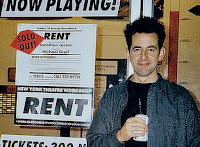
In 1996, I was 19 and I had just put my papers in to serve a mission. On my way home from a meeting with my bishop, I heard an interview on the radio with some of the cast members of a new Broadway musical called RENT. They played “One Song Glory”, and I was so overcome with emotion that I had to pull over on the side of the road to listen to this beautiful song. I bought the soundtrack the next day and listened to it over and over again in my bright blue 1993 Mazda 323. I heard that they were selling tickets to RENT for $20, fitting for a show about artists struggling to pay their bills. The catch was that you had to wait in line all day to get the $20 tickets. No problem for me, I had all the time in the world! So I got to New York City at 3 am, and I waited on the trash-strewn street next to other young people waiting to get the cheap tickets. That night I sat in the second row of the Nederlander Theatre and basked in the one song glory of the original cast. I knew what I was seeing was special, but I didn’t really appreciate how incredible it was to witness live performances from Idina Menzel, Anthony Rapp, Adam Pascal, Jesse L. Martin, Wilson Jermaine Heredia, Taye Diggs, and yes even Daphne Rubin-Vega.
RENT would go on to be the 11th longest running musical in history, win the Tony for Best Musical, and would be one of only ten musicals to win the Pulitzer Prize (a feat shared with Sondheim’s A Sunday in the Park with George and Lin-Manuel Miranda’s Hamilton). It had a profound impact on my life, and shaped the way that I view people, art, humanity, love, and life. It’s a sad irony that Jonathan Larson, the creator of RENT died the night before his masterpiece debuted Off-Broadway. Like many of his songs, his life ended too abruptly. Truly, Jonathan Larson was a man who was haunted by time.
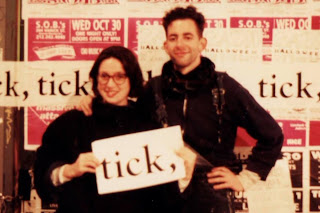
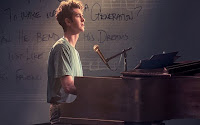
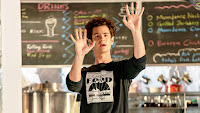
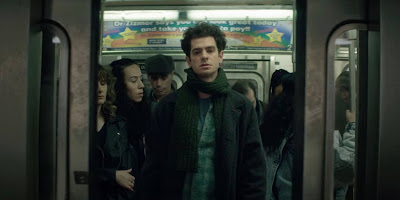
Larson’s obsession with time is evident in all his shows.RENT takes place over exactly one year. Tick, Tick… Boom! takes place in the week leading up to Larson’s 30th birthday. Superbia (which was never formally produced) is based on George Orwell’s 1984. Miranda, in his directorial debut, recognizes this central theme of time, and adds numerous symbols and references to time in Tick, Tick… Boom! (new to Netflix this week), including a constant tick tick ticking sound in the background whenever Jonathan feels stress and anxiety about his creative process.
There are some real treats in Tick, Tick… Boom!, chief of which include the song “Sunday”, a perfect homage and parody of “Sunday” from Sondheim’s Sunday in the Park with George. The song, besides being sharp and witty, features Broadway Royalty like Bernadette Peters, Bebe Neuwirth, Brian Stokes Mitchell, Chita Rivera, Renée Elise Goldsberry, Phillipa Soo, and Phylicia Rashad. Tick, Tick… Boom! also includes the song “Swimming” which cleverly shows how an artist’s inspiration might come in the most unusual of ways. And in particular, only happened for Jonathan Larson when he was relaxed and performing self care.
Overall, Tick, Tick… Boom! is an incredible film that at its base tells a compelling story of a creative artist. But it also is a lament on man’s struggle with time, which stops for no person. Tick, Tick… Boom! also beautifully and painstakingly chronicles the creative process, especially in the modern world where money, politics, and networking play such an important role in the creative process. This is a film written by a pained musical theater genius, directed by a modern musical theater virtuoso, and will be enjoyed by anybody who has any love for Broadway musicals.
I had a conversation with a friend about Dear Evan Hansen. She said, "Oh, I couldn't stand that movie. It was so dark and depressing. When I go to the movies, I want to ESCAPE! I don't want to be reminded of all the problems in the world." I countered, "Not me. When I got to the movies, I'm not looking for escape from my problems. I'm looking for CONNECTION. I want to relate to what I'm seeing, and gain perspective that help me with my problems."
I think this is a fundamental difference in approaching movies, and even in approaching the world. Neither is more right than the other (except the one that's my viewpoint -- that one is more right, of course).
Dear Evan Hansen was definitely heavy. I wouldn't call it dark and depressing, even though it certainly dealt with big topics like suicide and depression and mental health. But to me, what was more important than the tone of the movie was its relatability.
I first saw DEH on Broadway, just two months after my best friend died by suicide. It was gut wrenching and raw and difficult to watch. But cathartic at the same time. I related to Evan being the last one to talk to Connor before Connor's suicide. I related to his feelings of helplessness and despair. I related to Evan's own suicidal ideations.
Watching the show anew, two years later, all the feels hit even harder. I still connected with the messages about suicide and feelings of hopelessness, even though I'm further removed now from witnessing my friend's death. But watching the film version of this story brought about different connections for me. I related to the social anxiety Evan exhibits, and couldn't help but think of my own kids and the struggles they have. I know this is not what Evan Hansen has, but I have a child with autism who is amazing and has the most incredible brain. I have another child who struggles socially, and often feels like they "have always been that barely-in-the-background kind of guy".
Watching Dear Evan Hansen in the movie theater, I didn’t want to escape life. I wanted to connect. I wanted to feel my feelings, as raw and ugly and complicated as they might be. Feelings can be tough to face sometimes, and it feels like they are somehow easier to access when watching a show with a story or characters I can relate to. At least, this is my experience. I don't want to escape my feelings, I want to feel them. Because in the end, just like Evan learns, I want to let the sun come streaming through, I want to live my life. I want to be alive. I want to connect, not escape.
I don’t want to disappear.
If you are having suicidal ideations or you don’t know where to turn, please call the suicide hotline at 1-800-273-8255.
Spoilers about minor plot points in Schmigadoon are contained below.
Schmigadoon is a creative new meta musical about … being in a musical. It’s funny, smart, has some earworm songs, and boasts an outstanding cast. But at its heart, this musical is about finding true love. Because it has some characters who are from the cynical modern world, and some from the idyllic musical world, Schmigadoon finds a really nice balance between being ironic, and being earnest. So its message of finding true love also falls squarely in the center of the irony-earnest Venn diagram. I would sum up its message as “Relationships are not perfect and never will be, but you can find happiness in the imperfection. And THAT is true love.”
The relationship that intrigued me most in Schmigadoon was the marriage between Mayor Aloysius Menlove (cute name) and his wife Florence. I was intrigued partly because the characters are in an emotionally interesting situation, partly because there’s not much said about them in the musical, and partly because Alan Cumming is just such a captivating actor. The mayor is a closeted gay man, married to a straight woman. He comes out of the closet during the course of the six episodes, and expresses his attraction to another closeted character, Reverend Howard Layton, another closeted gay man who is in a similar situation with his straight wife Mildred (played by the indomitable Kristin Chenoweth).
These relationships between a gay spouse and a straight spouse are sometimes referred to as “mixed orientation relationships”. The two mixed orientation relationships in Schmigadoon are as unique as the individuals involved in them. The Reverend and his wife have a lopsided, emotionally abusive relationship. Yet the Mayor and his wife have a strong bond and a truly beautiful love for each other. The Mayor’s wife is proud of him for being authentic, and they both express their strong love for each other. (Just not, you know, bedroom love.)
There are so few positive portrayals of mixed orientation relationships. In truth, many fail. Most are difficult. Schmigadoon is no different. This was a comedic parody series, but also a show with heart. Yet the portrayal of the Mayor and his wife may be one of the most positive portrayals of a gay man and his straight wife I’ve ever seen in a piece of entertainment. I’m thinking of Tobias & Lindsay Fünke from Arrested Development. Frank & Cathy Whitaker from Far From Heaven. Ennis & Alma Del Mar and Jack & Lureen Twist from Brokeback Mountain. Those relationships are either comedic or painful. Or both. There is pain inherent in the mixed orientation marriage of the Mayor of Schmigadoon, but there’s also a sweet love and understanding. We don’t find out what happens with the Mayor and his wife, or what happens with the Mayor and the Reverend other than that they share a simple kiss. And maybe that’s for the best, since we don’t always know what path our own journeys will take us on in life. But in the meantime, we can appreciate the pain and the joys that people in mixed orientation relationships feel. We can celebrate diversity in relationships. And we can just love without an agenda, as Schmigadoon encourages.