I started out by playing Spyro the Dragon originally for PlayStation (now available as a remastered trilogy). Never played this one growing up, but I’d played the last game in the trilogy, Year of the Dragon. So it’s been a nice mix of a nostalgia (since the games are so similar) and a new game. It’s been in my video game collection for years, so why haven’t I played it? I don’t have an answer, but I’m glad I pulled it out at last.
Wednesday, November 22, 2023
Grateful for Nostalgic Video Games
I started out by playing Spyro the Dragon originally for PlayStation (now available as a remastered trilogy). Never played this one growing up, but I’d played the last game in the trilogy, Year of the Dragon. So it’s been a nice mix of a nostalgia (since the games are so similar) and a new game. It’s been in my video game collection for years, so why haven’t I played it? I don’t have an answer, but I’m glad I pulled it out at last.
Wednesday, November 23, 2022
It’s (an Attitude of Gratitude) Charlie Brown!
Thanksgiving this week has brought up the time to ponder and think a little on gratitude. Earlier, we looked up “Thanksgiving” on out tv, looking for a movie that sort of related to it, and lo and behold, what popped up was The Peanuts Movie, the 2015 film created by Blue Sky Studios and Charles Schulz’s son and grandson Craig and Bryan Schulz. This wasn’t something I had thought would be very much on the theme of Thanksgiving, and having considered myself a fan of Peanuts for pretty much my whole life, I was kind of shocked that I hadn’t seen the movie yet. My daughter and I managed to finish it, and we both really loved it! What came of the movie was a wave of nostalgia and enjoyment that was both poignant and timely, and I just had to write about it, including how I think it really does relate to gratitude.
The Peanuts Movie is very true to the comics and the
history of Peanuts. It’s well thought out, well-considered, and is
faithful to Charlie Brown (voiced here by Noah Schnapp of Stranger Things
fame), Snoopy, and the whole cast of characters, including the kit-eating tree.
The Peanuts adaptation into 3D was a genius homage to all the animation
that came before it, and must be seen in motion to appreciate fully. The film
is a little less melancholy than some of the specials I’ve seen in the past, but
it isn’t without those moments. It does end on quite a happy note, but it is
still all very real in the way it does; I hope I don’t spoil it too much (for
those, like me, who slept on this one) by going into some detail there…
With past specials like Arbor Day, Valentine’s Day, or
Christmas, they all involve some level of Charlie Brown failing to an extent: a
storm rains out the game that they were starting to win, or the only valentine
Charlie Brown gets is a previously used one, or the Christmas tree for the pageant
can’t even hold up an ornament—these all
are just screenshots of some of the moments that Charlie Brown feels like he
hasn’t succeeded. It’s in those moments that I think we all can relate, even if
it’s sometimes on a more “serious” scale as we grow into adults, and it’s not
something I fully appreciated as a kid. Life was easier and simpler then, and
now it’s full of setbacks and challenges. I think it speaks to good writing
when stories written for kids can touch us as adults too. In the movie, the formula
for failure is turned on its head: here, Charlie Brown actually gets 100% on a standardized
test, the first kid in the school to do so, which propels him into immediate
fame, and was given an award for it, along with an honorary “Charlie Brown day”
at the school. Earlier, He had failed to get the attention of the Little Red
Haired Girl at the dance, and he had embarrassed himself at the talent show,
and so this was the thing that he had held onto to buoy his self-worth. In a
twist, at the award ceremony, he is given the perfectly scored test, and realizes
it wasn’t his! He can’t accept the award, and he leaves the stage emptyhanded.
To top it all off, a beautifully written essay on War and Peace that he wrote
is accidentally shredded by the Red Barron wind-up biplane. He feels dejected.
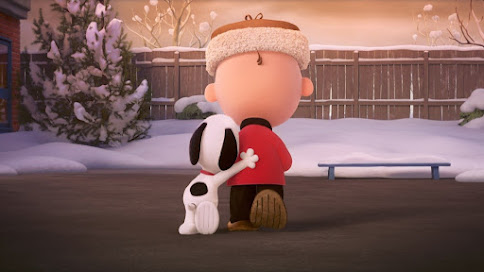
Following a powerful allegory of Charlie Brown’s inner
conflict portrayed by Snoopy’s battles with the Red Barron, Charlie Brown is
asked by a random kid in a park if he can help him fly a kite. He ends up
giving the kid advice, and it flies beautifully! Even when he couldn’t get a kite
to fly, he was able to see and appreciate the good in other people, and says: “You
can do it, don’t give up!” This plants the seed that he isn’t a terrible
person, and a pep talk from Linus gives him the strength and courage to realize
that maybe he can succeed, and he finally speaks up and talks with the Little
Red Haired Girl before she leaves for summer camp. Their conversation is insightful,
as she greets him by name:
“Oh, hi Charlie Brown!”
“You remembered my name?”
“Of course I did!”
“Before you leave, there’s something I really need to know:
why, out of all the kids in our class, would you want to be partners with me?”
“That’s easy, because I’ve seen the type of person you are!”
“An insecure, wishy-washy failure?”
“That’s not who you are at all!”
“I liked the compassion you showed for your sister at the
talent show, the honesty you had at the assembly, and at the dance: you were
brave and funny! And what you did for me—doing the book report while I was away—
so sweet of you! So when I look at you, I don’t see a failure at all: you have
all the qualities that I admire!”
Charlie Brown is a good man, even if he doesn’t always see
it that way. That’s one of the reasons I love this character, because I so often
am not cognizant of my own good qualities, I forget to give myself a fair shake.
You know how long of a time Charlie Brown was feeling sad for himself? All the
way from winter to the start of summer break. I’ve experienced long stretches
of time where I’ve dealt with failures and inadequacy: it’s easy to fall into
that trap. Often the answers to my problems have been right there all along, I
just needed to have listened. I just needed to see, to remember, to appreciate.
Which is really why I think this movie works as a Thanksgiving
movie after all: because giving thanks and gratitude, it’s all about learning
how to see good in the world, and showing our appreciation for how and why that
goodness exists. We can thank our friends for who they are. We can spend time
with them. We can remember names, and we can help them and be there for them,
even when they’re feeling down. We can thank God for the goodness in our lives.
Gratitude for all of these things is a springboard into greater appreciation
for ourselves, and greater capacity to act as well. We can continue to be there
and to offer advice, as Linus did at the beginning of the movie:
“Remember, it’s the courage to continue that counts!”
And later, Linus gave this crucial advice:
“Charlie Brown, it might be time to consider the wild
possibility that you’re a good person, and that people like you!”
In the office of Dallin H. Oaks hangs a recreation of
Maynard Dixon’s The Forgotten Man. It depicts a man sitting on the
ground by the gutter as streams of faceless, careless people walk past him. His
face is in the shadow, and the back of his head is illuminated by the sun. We
can be that man, as Charlie Brown was, and feel like we have no contribution,
or that we aren’t appreciated. Yet the Lord knows each of us. He knows the
words and the balm that will heal us, and make us whole. Gratitude, an attitude
of it and trying to give it not only to others but to ourselves, is part of
that healing, and that understanding is why he hangs that picture in his office, to remind himself to who gratitude for what we have, and to show that gratitude by helping to reach out to those who are struggling. A huge part of gratitude is remembering, much like the Little Red Haired Girl remembered Charlie Brown, and a huge part of gratitude includes remembering to show that thankfulness:
“Verily I say unto you my friends, fear not, let your hearts
be comforted; yea, rejoice evermore, and in everything give thanks; … and all
things wherewith you have been afflicted shall work together for your good” (D&C 98:1,
3)
“May we ‘live in thanksgiving daily’—especially during the
seemingly unexplainable endings that are part of mortality. May we allow our
souls to expand in thankfulness toward our merciful Heavenly Father. May we
ever and constantly raise our voices and show by word and deed our gratitude to
our Father in Heaven and to His Beloved Son, Jesus Christ.”
And I would add, let us show that gratitude by being
merciful and grateful to those around us, and to ourselves as well. Life is full
of challenges, but we don’t have to let them overcome us! We can reach out, we
can love, we can sacrifice, and we can be grateful, and it will work together
for our good. Those are just a few of my thoughts after watching The Peanuts
Movie, and so I hope you can get something from it too.
Wednesday, May 25, 2022
From Dad Bod to God Bod
(Guest post by B)
“Dad bod” is a slang term in popular culture referring to a body shape particular to middle-aged men. The phrase has been adopted in U.S. culture to refer to a male who was once particularly lean or fit, but over time has gained an excessive amount of body fat, typically around the waist, leading to a "beer belly". ---Wikipedia
In the recently released trailer for Thor: Love and Thunder, one line from Korg the stone-like Kronan warrior goes into storytime mode with the line “He went from dad bod to god bod.”
This line, while incredibly humorous and relevant in our day, instantly hit me as a reminder of our own individual divine potential.
As Latter-day Saints we understand that all people are children of Heavenly Parents and have the potential to become like Them (see Acts 17:29; Ephesians 4:6; Hebrews 12:9). The Savior’s admonition to become perfect as He is perfect is an evidence of our divine potential.
Many features found on earth give rise to powerful scriptural symbols. The wildernesses of Jared, Moses, and Lehi symbolize the testing of faith. The thorns and thistles that came after the Fall typify the trials of mortal life. These symbols teach us about the nature and purpose of mortality, but they do not teach us that we should think negatively of the earth. After all, the Lord Himself has declared the earth to be good.
Divine patterns, then, are the processes, fundamental laws, principles, and truths that the Lord seems to follow in ordering and organizing his heavenly and earthly realms. In revealing these divine patterns to his mortal children, the Lord reveals his patterns of truth and righteousness, which, if identified, understood, followed, traced, copied, or imitated, will give us additional motivation to cleanse our souls of earth-stain, crack through accumulated earth crust, and retrace the patterns to our heavenly home.
We can draw three lessons from nature’s grandeur: first, God exists; second, God is powerful; and third, God loves us. One way we can feel a surety of the Creator’s existence is to observe His handiwork. A marvelous way to do this is to gaze into a star-filled sky on a moonless night or to watch the many varieties of summer bee and butterflies on a single lavender bush. As Alma taught, “All things denote there is a God;”
The knowledge of God’s existence teaches us of His power.
We are keenly aware of God’s majesty and power when we see His handiwork in motion. Next time you stand at the foot of a roaring waterfall or at the toe of a mighty glacier, reflect on the power of the Creator.
The very existence of this earth impresses upon us the reality that God loves us. Our answer may be found in asking another question: how important must mankind be to God, seeing that He has created all of this for us? We are surrounded by signs of God’s love for us.
There are other fundamental lessons to draw from the Creation—lessons of what the Creator might expect from us. By virtue of living upon the earth we shoulder two responsibilities. The first is to care for our beautiful home.
At the Creation of the world God placed Adam and Eve as caretakers, with dominion over “every living thing that moveth upon the earth,” and gave them instructions to “replenish the earth, and subdue it” (Abr. 4:28). The earth, then, was created for us and given into our care. It is within our power to do with it what we like, but since it is God who entrusted it to us, it is to Him we shall answer for what we choose to do.
A second responsibility man owes is gratitude. Gratitude is an essential ingredient in accepting any gift from God.
We can show gratitude by following the second great commandment to “love thy neighbor as they self”
As followers of Christ, we all have a responsibility to create a supportive and loving environment for all God’s children. Such a support network makes it much easier to live the gospel and to seek the Spirit while navigating any aspect of mortality.
So then, how do we put off the natural “dad bod” in us all and become, as Korg put it a “god bod?” We gain an understanding of our individual divine potential. We seek a personal knowledge of our Eternal Father’s existence, His power and His love for us. We strive to follow divine patterns, help others along our way, and do our very best to follow the Savior’s admonition to become perfect as He is perfect.
We are made in the image of our Heavenly Parents, and they don’t make mistakes. As we come to understand those parts of ourselves we don’t initially like, our emotions, fears, attractions, difficulties, or physical imperfections we can take comfort and know we are just as THEY need us to be.
Wednesday, December 23, 2020
Every Good Gift
“Behold, I would exhort you that when ye shall read these things, if it be wisdom in God that ye should read them, that ye would remember how merciful the Lord hath been unto the children of men, from the creation of Adam even down until the time that ye shall receive these things, and ponder it in your hearts.” (Moroni 10:3)
As we finish off the year and celebrate Christmas, it was perfect timing to read Moroni 10 with the Come Follow Me reading schedule. I was impressed this year by the phrase “every good gift”. It’s easy to think of Christmas presents when the word “gift” comes around, especially at this time of year. However, the gifts of God are innumerable.
“And I would exhort you, my beloved brethren, that ye remember that every good gift cometh of Christ.” (Moroni 10:18)
In this final chapter of the Book of Mormon, Moroni talks specifically about spiritual gifts (i.e. gift of healing, gift of teaching, gift of tongues, etc.) but I believe he’s also referring to everything that the Lord blesses us with.
It’s been a challenging year for many people. I’ve been blessed that all this quarantine and home time has given me extra time with my daughter as she’s spent her first year getting acquainted with mortality. Besides the fact that my schoolwork went online instead of on campus, my life has remained relatively stable. That being said, I know not everyone has been so blessed.
But as President Nelson counseled us before Thanksgiving, we can #givethanks and feel the blessings of Heaven more fully in our lives. Pessimism never blessed anyone, so I’ve come to truly believe in the power of counting our blessings. So as we spend Christmas together with loved ones (even if it’s limited to virtual time this year), let’s be grateful for the gifts that our Father in Heaven has given us. Every good thing comes from God, so let’s be grateful for it.
“And again I would exhort you that ye would come unto Christ, and lay hold upon every good gift.” (Moroni 10:30)
Monday, November 23, 2020
#GiveThanks
The tradition of posting online what you're grateful for around this time of year is nothing new, but did you notice that before Friday the November gratitude posts seemed a little more scarce than in earlier years? It's almost as if it was hard to think of things to be grateful for in 2020. How odd I wonder why....
President Nelson's call to give thanks has ignited this year's wave of Thanksgiving posts right on time. The holidays were just not feeling all that holiday this year, since at time of writing gathering with those outside of one's household is off limits in Utah and the numbers of COVID-19 infections are still going up. This was starting to shape up to be one of those cheesy holiday specials where somebody comes by and steals Christmas.
Which brings me to the geeky side of my post: This reminds me of "How the Grinch Stole Christmas", the original animated piece not the Jim Carrey one or the CGI thing. If you remember when the Grinch is listing all the things he hates about Christmas (Which I get) at the very end he says "And those Who's big and small will stand hand and hand, and start singing". After the Grinch steals Christmas he stands on his mountain, hand to his ear to hear the misery his great theft has caused. This was the world last week, as the holidays grew closer, the joy robbed and distorted in them. Anxiety uncertainty and fear raged as it looked like the holiday spirit just wasn't going to come.
Then, over the hills, the #GiveThanks posts started arriving. Like the Who's song, "it came without ribbons, it came without tags. It came without packages boxes or bags!" It came because of the call of a prophet, reminding us that the holidays don't come from a store, or tradition, or normality, the spirit comes from within us. It comes just the same.
This is the first time in a very long time that the Christmas movies are right, that the holidays are in danger. Thanksgiving looks pretty good but once however it's celebrated happens let's try to keep the momentum going and remember what's really important about this time of the year. With the holidays pillaged we need to double down on what's really important, prove that we don't need the excess to celebrate, that we don't need a good year to have a good Thanksgiving, what we need is our faith, in each other and in our Father in Heaven.
-JOE
Thursday, November 27, 2014
An Attitude of Gratitude
And just to add a little more geekiness to this post, here are some parodies of Norman Rockwell's classic painting, "Freedom From Want."