Showing posts with label redemption. Show all posts

Monday, July 7, 2025

A Daredevil Devotional: Being Born Again

(Guest post by Ben)

**Spoiles for Daredevil Born Again Season 1**

“It’s hard to come to terms with a violent nature. Hating the power that it has over us.”

“I was raised to believe in grace. That we can be touched by the divine and transformed into a better person. So, if you say to me that you’re a new man, I say, “Fine.” But you should know, I was also raised to believe in retribution. So, if you step out of line. I will be there.”

This loaded exchange between Wilson Fisk and Matt Murdock in the opening episode of Daredevil: Born Again is foreshadowing for the plot of the entire season. Fisk is running for mayor and though he has fooled much of the city into thinking his previous arrests were by corrupt cops and that he is truly innocent, he knows that Matt Murdock knows the truth. He also knows that Matt wrestles with his violent nature while wanting to believe in his goodness. This season of Daredevil asks the question: can we really change? Satan, and Fisk, would have us believe that we can’t, that its only a matter of time before our nature takes over. All we can do is put on a fake mask in an effort to manipulate others. Matt Murdock wants to believe he can change, but isn’t so sure and, throughout this season, wrestles with dramatic versions of what we all wrestle with—the natural man and the desire to become something more. 

Of course, be warned, there will be a few spoilers in this devotional!

Ever since my first year of early morning seminary, Mosiah 3:19 has been one of my favorite scriptures: 

“The natural man is an enemy to God…unless he yields to the enticings of the Holy Spirit, putteth off the natural man, and becometh a Saint through the Atonement of Christ the Lord.” 

I have always found comfort in the belief that who I can be is not limited strictly to my natural, genetic, biological self. There is divinity within me and I can become more than my nature through the enabling grace of Jesus Christ. There’s a word that describes “more than nature”—supernatural. The word King Benjamin uses is “saints”.  But how do we become “supernatural saints”, or as Matt Murdock put it, how can we be “touched by the divine and transformed into a better person”? Like the Daredevil, we have to be born again. 

The character arc for Matt is his efforts to fight evil in a new way. The season starts with his best friend being killed by Bullseye, the man he sent to prison at the end of the previous series. This death is absolutely devastating for Matt; it is transformative for his view of the world and how to make a difference. He retires the Devil of Hell’s Kitchen and commits to changing the city through the legal system (Matt is an attorney).  However, he watches helplessly as his efforts to defend the innocent and prosecute the evil feel like a toy hammer against a mountain. 

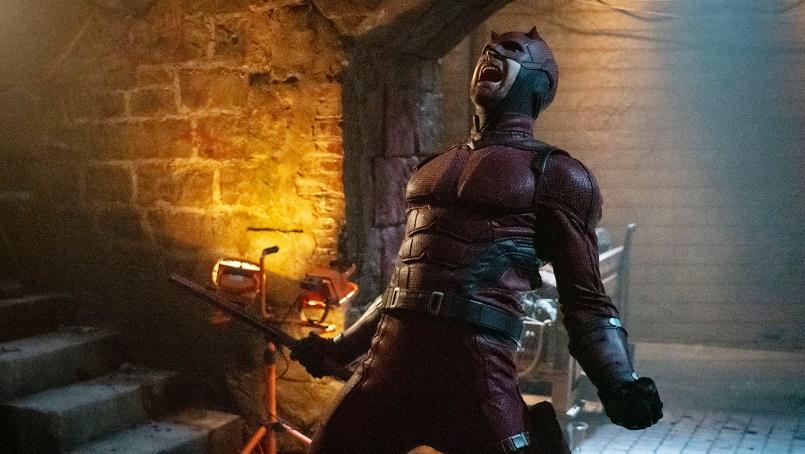
At the end of episode two he is attacked by two dirty cops and by instinct defends himself violently. After defeating them, he screams in frustration. Is this all he is? Is this what it will always come back to? The vigilante self that he resists is a profound metaphor for the messaging we all receive from Satan. It is as if the Devil himself, Satan, is in his ear, “you can’t change who you are! THIS is who you are! Give in!”. 

Later in episode four, he seeks out the Punisher because one of the dirty cops is using bullet casings with punisher logos on them. This interaction is a powerfully introspective experience for Matt. The Punisher challenges why he is really there and what he really wants. As if he were voice of the devil inside him, Punisher pushes, 

“I don’t think you came here for my help. I think you want my permission…you’re guilty. That guilt that shame, that’s my home, and I can see it on you, I can smell it on you, its all over you.” 

Just like Satan, who wants everyone to be as miserable as himself, he tries to make Matt lean into his carnal, basic, natural self. He wants him to embrace his inability to change who he is. He continues to antagonize Matt until Matt loses his temper and punches him in the face—the devil inside him briefly coming out. Matt immediately apologizes, gripping his fists and breathing deeply trying to shove that side of him back deep down. “Sorry, I apologize.” To which the Punisher responds, “What are you sorry for? First honest thing you did, Red.” 

There are many more scenes that further illustrate Matt’s struggle with the devil—his struggle with the world around him and the means to his worthy ends. But in the end, the series finishes as you would expect. The Devil of Hell’s Kitchen returns—he finally “gives in” when a young woman has been taken by a serial killer and Matt knows the police won’t be fast enough to save her. In dramatic parallel fashion, the scenes of Daredevil saving this victim are interwoven with scenes of Kingpin violently beating a man he has a personal vendetta against.  The message seems to be that Kingpin was right, no one can resist their violent nature, neither of them have changed.
Daredevil: Born Again Season 2 Will Be a "Resistance Tale"

But Kingpin, and Satan, are wrong. Matt has become something new—just not the new that he thought he was becoming. In the climactic conclusion to the season (which ends on a cliffhanger, things aren’t even a little bit resolved here!), Daredevil realizes he can’t do this alone, and the change he needed to make was one of working together with the system—not abandoning his unique strengths and abilities, but embracing the help of others and forming a team. Fisk has declared martial law in New York City, and is now brutally killing those who won’t follow, but the final scene is Daredevil walking into a room filled with citizens who want to stand up to this regime. Daredevil has changed, and he isn’t just a manifestation of a violent natural self. In saving the girl from the serial killer, he was motivated to protect, not to hurt, and in working with others he is not serving himself.

This is how we become supernatural saints. It is through our baptismal and confirmation covenants. First, we must be born again by water—through the covenant of baptism (John 3:5). In this ordinance we covenant to mourn with those that mourn, comfort those that stand in need of comfort, to take upon us the name of Christ and serve one another—to work together as a team (Mosiah 18:9). Then, we can become sanctified by the reception of the Holy Ghost (3 Nephi 27:20). I served a mission in Albania, and in the Albanian language, the phrase “to be sanctified” from that verse was literally translated as “to be made a saint”.  In other words, to be “saint-ified” means to receive the Holy Ghost by listening to Him—to yield unto the enticings of the Holy Spirit (Mosiah 3:19), and that is how we become supernatural saints through the grace of Jesus Christ.  As we follow His direction, and allow the Holy Ghost to change our choices and behaviors, the Savior strengthens us and we come more than our base, natural selves.  We are born again as saints, but saints are not completely different beings—we are still ourselves, we are still the same person, just better versions of us. The Daredevil didn’t need to disappear, he just needed to change. 

The change he goes through is the one we all go through—embracing interdependence and working together to change ourselves and the world around us. Just as Matt couldn’t change New York City himself, we don’t build Zion alone. It starts, first, with a partnership with our Savior, and second, a partnership with those around us (Matthew 22:37-40).

Wednesday, June 7, 2023

Why Girl Meets World is Still Relevant


Despite some fans’ opinions, I genuinely love Girl Meets World (sometimes more than Boy Meets World). It didn’t have mature subject matter, like Boy Meets World, since it was on Disney Channel and not Freeform. Regardless, it didn’t stop them from addressing powerful real-world issues. So just like I did with Boy Meets World, I want to illustrate why Girl Meets World still matters, even years after the series ended.


Bullying

Girl Meets World devotes a couple episodes to bullying. The world we live in doesn’t often have Harley Keiners pushing us up against lockers on a daily basis. However, we are hit with words from every direction. In “Girl Meets Rileytown”, Riley was being constantly attacked by the words of a virtual bully at her school. You can’t even look at Facebook without someone faceless individual tearing into someone. We can’t control how they act, but we can control ourselves. Like Riley and Farkle (in “Girl Meets Farkle”) learned, it’s up to us to own up to who we are, faults and everything, and be confident in who we are (still working on that myself). If we know who we are, angry people on the internet won’t be able to shake us. 


Forgiveness

Maybe this one seems a bit basic, but in “Girl Meets Forgiveness” we see a more complex side of forgiving people. Sure, there are incidents like Lucas and Zay’s complaints against Farkle that you need to forgive and get over. But there are also hard issues, like Maya forgiving her father, that hit home. I never had to worry about divorced parents, but I’ve had to forgive myself for things that weren’t my fault. And that was Maya’s bigger issue. Sure, it’d be ideal and great to eventually forgive her father. But she was able to forgive herself and stop blaming herself for him leaving. It’s one of the moments that nearly brought me to tears.


Religion

In many respects, religion and politics are among the most taboo subjects of conversation. And “Girl Meets Belief” did a great job demonstrating what civil discourse (at least in the context of religion) can look like. We don’t get anything explicitly said about characters’ religious beliefs (except Farkle’s position as an atheist), but it’s heavily implied that Maya is agnostic and that Lucas and Riley are Christian (though even that is a little subjective). With differing religious beliefs, it can get tense (see Community’s “Comparative Religion”), but I like how the kids were led to appreciate each other’s beliefs and to keep an open mind to understand how others believe. The world could use more of that.


Divorce

With Maya’s story arc, you get a bigger picture of divorce and the effect it has on kids. But I particularly love how in “Girl Meets High School” we get it from another perspective, as Ava’s parents are in the middle of separating. Things come full circle and Maya is able to share what she’s learned from her parents’ divorce: “When people you've loved all of your life suddenly decide to leave? Well, you sit by yourself for a while and you'll try to figure it out. And you'll blame yourself. But it isn't your fault. You probably won't believe that, though, and you'll think you did something wrong, but... you didn't. It isn't your fault. And most of all, you stay with your best friend. People make their own decisions. And sometimes, they decide to go away for a while. Sometimes, it takes time to understand why. It isn't your fault.” And that bit about “Stay with your best friend” could honestly apply to any trauma, not just divorce.


The Secret of Life

From early on in the series we get the lessons about the “Secret of Life”. While I wouldn’t necessarily call it “gospel truth” there’s something to it. But I think Cory was certainly right about one of life’s secrets: People change people. I don’t think anyone would disagree that the people we choose to associate with influence us. And the people we choose to not associate with. Do you let someone build you into a better version of yourself? Do you choose friends who lull you into complacency by never challenging you? Or do you choose friends who drag you down into a gulf of misery? It seems straightforward and easy on paper, but real life is messier than that. 


So as my wife and I finish Girl Meets World again, I want to quote one of Mr. Feeny’s last lines from Boy Meets World (which is posted to the wall of Cory’s classroom): “Believe in yourselves. Dream. Try. Do good.”

***

Join us on our new Discord server to stay up to date and interact with other LDS geeks.

Monday, May 22, 2023

Daddy Issues: Zuko Finds His Honor

The honorary title of this blog is, “Honoring the Honorable Way of Honor, Honorably, Your Honor.”

Just wanted to make sure we understand that Zuko cares about one thing.

And that’s capturing the Avatar.

Why?

Because he is missing something he needs to regain.

You guessed it.


Is regaining your honor such a bad thing? In Zuko’s case, it’s the fuel for a maddening obsession, and the central theme of his daddy issues. He’s totally blinded to the fact that he spends two books of ATLA on a quest that's nothing more than a mockingly titled banishment. He and Uncle Iroh are a pair of royal outcasts, together in their disgrace and their longing for family who have either died, disappeared, or dismissed them.


Zuko believes he needs his father to restore to him what he lost at their agni-kai, the fateful day he signed his hatred on Zuko’s face with fire. He believes to recover means to reclaim his rightful place on the throne.


And then Zuko does the impossible and captures the Avatar at the North Pole. So why does he wanders off into the tundra? When Azula attempts to take him in, Zuko and Iroh escape and live on the run. Zuko learns that he will never find the honor that he hoped he would find from his father. He and Uncle Iroh take knives to their top-knots, and travel in disguise, branded as traitors to the fire nation. Then at Ba-Sing-Se when Azula and Zuko battle the Avatar team, Zuko bears the weight of a shared secret, that they did not actually kill the Avatar, as they tell their father they did. He also is crushed by the knowledge that his return to the throne was bought with Uncle Iroh's incarceration.


That’s rough, buddy.


Ba-Sing-Se, is a very important moment for Zuko, though, and the progress Zuko shows here gives the viewer a sense that when Zuko returns to the Fire Nation, there is still hope he won't follow in his father's fascist footsteps. Zuko learns that the Avatar is present in Ba-Sing-Se, but he follow’s Uncle Iroh’s advice, and lets him go. This decision actually causes Zuko to get sick for a few days, and Iroh nurses him back to health while he rests in the back of their little tea shop. When he wakes up, it’s as if he is transformed into a new person. Someone who is capable of being a whole human. He goes on a date. He begins to envision a life that has nothing to do with the Avatar. This is a signal of major healing from his ‘daddy issues,’ more so than cutting off the top knot. Rather than trying to fill the emptiness in him by getting Ozai’s approval, Zuko begins to ask himself what he, himself, approves of. He fights his way to move beyond his traumatic childhood, and determines to break the mold set for him by choosing to live differently.


The way I would describe Zuko’s transformation in a phrase is a shift from external validation to internal validation. Childhood is a time where we don’t have the development necessary to provide ourselves internal validation. We have to rely on the adult role-models in our lives to know how to be in the world. Our internal sense of right and wrong is heavily influenced by the values that those role models demonstrate through their actions. Later, as our brains develop we begin to have the words and cognitive tools to truly choose for ourselves, if we choose to. While the mold set by our parents and role models is strong, it's not impossible to break. Living by internally validated models make it possible to be free from toxic patterns set by a traumatic family of origin.


Speaking of toxic families, Zuko was torn between two very different parents. His inner conflict manifests in his highly unstable mood, and his poor planning of events. He has trouble making up his mind because the path of Fire Nation supremacy is full of holes, but he refuses to fully acknowledge them.


The royal family of the Fire Nation demonstrates that individuals have very different ideas about what honor means. Princess Azula was highly attached to her father, Ozai, a man motivated by the pursuit of domination, willing to achieve his goals at any cost, including selling out his older brother, and banishing his wife, the mother of his children. To Ozai and Azula, honor is about conquering and conniving. Zuko was more closely bonded with his mother, a woman whose values included kindness, and sticking up for other people. She saved Zuko’s life by leaving the Fire Nation palace forever. Despite the fact the Zuko’s journey is spent desperate for his father’s approval, he is conflicted because he doesn’t agree with Azula and Ozai’s definition of honor. Zuko does many horrible things on his quest to capture the Avatar. And yet, he also rescues the Avatar from General Zhao, disguised as the Blue Spirit. He intervenes in the Earth Kingdom on behalf of a little boy, being antagonized by brutish Earth Kingdom soldiers. Although Zuko says that he must restore his honor through his father, he is conflicted, because at times what he believes is right is the exact opposite of what his father would do.


Zuko’s Blue Spirit disguise (my true favorite character from the Avatar series), his solitary acts of selfless bravery, and his ultimate loyalty to Uncle Iroh all indicate to me that his internal conflict, and the fever-transformation in Ba-Sing-Se were steps on a journey to reaching a state where his actions are motivated by internal validation. Zuko learns to make decisions based on values beyond power and prestige. He defies his father openly, and fights down Azula as a member of team Avatar because he chooses to believe his sense of what is right will show him the world more clearly than the lenses he was taught to wear as an heir to the throne. He lost his fire-bending for a while because he lost the fuel to power his bending: contempt, resentment, and frustration. While impressive, his anger made his bending volatile, unreliable, and undisciplined. Yet, when he regains his power to bend, and teams up with the Avatar, he at last finds focus, a quiet mind aligned with the life he desires to have for the long term.


Zuko finds his honor, but not with Ozai. He finds the honor that his mother, Ursa, and Uncle Iroh intended for him to find. He finds out that there was nothing to regain from Ozai but abuse, neglect, and despair. He finds that when Azula is defeated, her effortless poise and perfection were a mask for emptiness and total, sociopathic isolation. Zuko finds that his worth never came from his throne, his bending skills, or his father's approval. Despite Zuko’s journey across the spectrum from enemy to ally of the Avatar, his worth was always totally clear to the Uncle who had adopted him as his own.


Zuko not only becomes a whole person capable of connecting with people, he is willing to apologize, make amends, and fight for truth. Holding fast to his new way of living means saying goodbye to Ozai and Azula. He is able to face the unknown, living amongst a group of misfits and strangers, and finding his way to the throne that echoes his grandfathers, Avatar Roku and Firelord Sozin, and hints at an intergenerational healing of their failed friendship. The unfamiliarity of his new world view is bearable because he has finally learned to follow deeper values. Like Iroh and Ursa, his estrangement and loneliness don’t lead to isolation. He finds honor through trust, vulnerability, and empathy. Zuko is no longer chained to his inner emptiness because he has let go of the quest to fill it.


“I’ve realized I’m free to determine my own destiny, even if I’ll never be free of my mark.” -Zuko


Determine your own destiny. That is a quest worth becoming obsessed with.

Wednesday, July 27, 2022

The Year I Finally Understood Scrooge


(Guest post by David)

Perhaps like many of you, growing up I was introduced to different media interpretations of Charles Dickens’ novel, A Christmas Carol. It started with Disney’s animated adaptation, Mickey’s Christmas Carol, where Mickey Mouse played Bob Cratchit and Scrooge McDuck starred as the money obsessed Ebenezer Scrooge. Later, I watched the 1970’s Scrooge, a live-action musical film with actor Albert Finney (pre-Annie Daddy Warbucks) as the titular character and Jacob Marley brought to undead life by Sir Alec Guinness before he taught the world about “the Force.” In between these, I saw Kermit the Frog, Miss Piggy, Gonzo the Great, and other Muppets tell their own version, with Scrooge performed by British actor, Michael Caine in The Muppet Christmas Carol

From each of these retellings, I always came away with a firm dislike of Ebenezer Scrooge. To me, he was a mean, selfish, frightening man. I was glad at the end of each film when he finally reformed. These negative feelings toward Scrooge were entrenched for decades until the year I unexpectedly saw Mr. “Bah, Humbug” in a new light. 

The year was 2005 (or 2004, this detail has grown vague over the years), and I was celebrating the holidays with my family in Michigan. One evening before Christmas, I was decorating the tree alone, and had the television on in the background. It was tuned into the Disney Channel which so happened to be airing The Muppet Christmas Carol. I decided to listen to it while I trimmed the evergreen. As I was stringing lights and hanging ornaments on the branches, I noticed that I was paying closer attention to the story even though I’d seen this movie countless times before. I particularly paid attention to the events and choices that molded Scrooge’s life. 


I finally realized that Scrooge spent a lonely and (what appears to be) a largely friendless childhood. To fill the void, he focused on his education, and as a young adult, pursued his career. At one point in his life, Scrooge found love with Belle, a young woman whom for a time he wanted to marry. Sadly however, Belle broke their engagement because Ebenezer prioritized success and riches over their relationship. These insights into Scrooge not only helped me understand why he became “a squeezing, wrenching, grasping, clutching, covetous, old sinner,” but also assisted me in surprisingly discovering that I related to him. 

I could empathize with Scrooge keeping his nephew, Fred at a distance, and not allowing others into his life. Growing up, I was very shy and struggled with social anxiety. As a result, I preferred activities that didn’t necessarily require others. With people outside my family, I avoided social interactions as much as I could. I rarely had friends, and when I did, some of them would join peers in teasing and bullying me, or simply disappeared. From this, I painfully learned that people in general couldn’t be trusted, and that I had to protect myself by keeping them at a distance or cutting them out of my life. 

I saw that Scrooge and I were similar in the way we dealt with our emptiness. Ebenezer threw himself into his studies at school. Afterward, he worked to become partners with Jacob Marley, and then concerned himself in acquiring money. I engaged in solitary hobbies and interests. My college life was focused on earning an education, and upon entering the workforce, I devoted myself to my employment.   

I did notice that one difference between me and Scrooge is how we interacted with people. He didn’t seem to care if he was nasty, angry, and miserly with everyone. I on the other hand felt it was required to be unfailingly polite, bubbly, and friendly with others, while inwardly feeling anxious, alone, and in emotional pain. But even in this aspect of our lives, Scrooge and I were essentially the same, we both were unhappy. 

It has been almost 20 years since that December night. Like Scrooge, I have experienced change and healing. I allow people into my life, include them in my interests and activities, and I even have close friends now. I also no longer view Scrooge as a heartless villain. Now I see him as a nuanced individual shaped by things both within and outside his control. I enjoy following Scrooge’s journey of redemption through the divine interactions with Jacob Marley and the Ghosts of Christmases “Past,” “Present,” and “Yet to Come.” In addition, I appreciate different versions of Scrooge’s story, such as Jim Carrey voicing Ebenezer Scrooge in Disney’s computer animated film, Barbie in A Christmas Carol's Eden Starling (a female variation of Scrooge), or “A Hearth’s Warming Tale’s” Snowfall Frost in My Little Pony: Friendship is Magic. Each remain true to the character’s ultimate healing and transformation into “as good a friend, as good a master, and as good a man as the good old city ever had. And it was always said of him that he knew how to keep Christmas well if any man alive possessed the knowledge.” 


“God Bless Us, Everyone,” and Merry Christmas (in July)! 

Wednesday, April 28, 2021

The Redemption of Bucky Barnes

The Bucky Barnes story has always been about redemption. A man who was a trained assassin, looking to better his life after making so many mistakes. So many elements of his story can be seen in Jason Bourne, Anakin Skywalker, or Wolverine in Logan: ruthless killers who want to turn their lives around. But the concept of redemption doesn’t just apply to murderers and assassins. There are parallels to Bucky’s redemption story that can be drawn with Jean Valjean in Les Misérables, with Phil Connors in Groundhog Day, or with Alma the Younger. Or with each of us. 

John Walker also has a redemption arc in The Falcon and the Winter Soldier, the Marvel series which recently wrapped up on Disney+. At first it was a little infuriating that they portrayed John Walker so blatantly evil. I mean, the guy brutally kills a dude in public after only, what, three days as the Wish Version of Captain America? I wanted more gray area with Walker, I wanted him to be more outwardly perfect and inwardly evil. But then when I looked at John Walker’s story as a parallel to Bucky’s story, it made more sense. Walker is a killer, a super soldier whose power got the better of him, just like the Winter Soldier. And the only way to redeem oneself from such depths is to make some changes. These changes don’t make up for the past, and certainly don’t erase the horrible memories of previous atrocities. But they do help put your life in balance.

And of course the same applies to us. None of us is perfect. We all fall short. If I am being honest, I have done some things in my life that have really gone against my core values. I haven’t killed anybody (though that lady in front of me at Walmart who wanted to pay in pennies sure came close!) but I have hurt people, and I have hurt myself. My past is messy and I have been lost before. Very, very lost. 

But I own those choices. My mistakes are my own. I admit where I have fallen short, I know where I have erred. And I have learned from my past. Like Alma and Bucky, I “zealously strive to repair all the injuries I have done”. We are shaped by our past, but we do not have to be controlled by it. Our choices today are really the only things that matter. Like Master Oogway says, “Yesterday is history, tomorrow is a mystery, but today is a gift. That is why it is called the present.”


Monday, January 25, 2021

Who is Zelena?


My wife and I are currently working our way through Once Upon a Time again for the second or third time since the series concluded. We’re coming up on the introduction of one of my favorite characters from the series: Zelena, the Wicked Witch of the West. Because she’s awesome, I’m going to feature her in my first character spotlight. But first a brief history on the Wicked Witch, in case it’s been a while since you’ve seen the series. 

Zelena was fathered by Jonathan, Prince Leopold’s gardener, under the guise of being a prince himself. Knowing she couldn’t climb the social ladder as a single mother, Cora sent Zelena through a portal to Oz to give herself a fresh start. She was taken in and raised by a couple in Oz, but her adopted father becomes more abusive after her mother dies. He convinced her that her magic was a curse that made her wicked, which was only reinforced by others in Oz as she grew up.


As an adult, she was taught by Rumpelstiltskin to control her magic. When he rejected her affection, she retreated to Oz and plotted to travel to the past to change her fate. Along the way, she made friends with Glinda and Dorothy and fell in love with Hades, but because of her past she got insecure and self-sabotaged any attempts at love. 

Years later after Regina’s dark curse was reversed, she plotted to take the Charmings’ baby to complete her time travel spell. This scheme led the Enchanted Forest back to Storybrooke where she would eventually cast her time travel spell before seemingly being killed. She lived on and managed to masquerade as Robin Hood’s wife, Maid Marian, to split him up from her half-sister Regina.


By the time her masquerade ended, Zelena was already pregnant with Robin’s child, ensuring her safety (and it resulted in her being dragged to Camelot). After the baby was born, she was banished by Robin and Regina to Oz. However, it wouldn’t be long before she followed them to the Underworld where she reunited with her daughter and her love, Hades. After Hades and Robin are killed, she tries to bond with Regina. It’s touch and go for a while, but by the end of it all, she becomes an anti-hero we can all love.

Long after the “Final Battle”, Zelena and her teenage daughter Robin go to the New Enchanted Forest to help Regina, Henry, and new friends. When Drizella’s curse hits, Zelena takes on the persona of Kelly West, who eventually leaves Hyperion Heights to fall in love and teach spin classes in San Francisco. She’s brought back to Hyperion Heights by Regina/Roni and Henry, but heads back home when her fiance is put in danger. In the end, she joined her friends and family in the United Realm/Storybrooke.


She started out as the most despicable villain, willing to hurt a child to accomplish her plans. But as time went on and she felt love from her daughter Robin and her half-sister Regina, she softened and became a good person. Looking at her as a survivor of abuse and abandonment, it makes more sense. I’m no expert on abuse, but something we all need is love. And when you give someone love (and they choose to receive it), things can change. Like her sister, she had a heaping of character development over her five seasons and she became (along with Regina) one of the most redeemable aspects of Once's soft reboot in Season 7. Honestly, it wouldn't have been worth it without the two of them.

I think the reason I love Zelena is because she’s relatable. We all have trials we’ve gone through and we all crave love. And especially nowadays, I think we all have a little bit of dark humor. Even when she becomes a hero, Zelena isn’t too far away from a snarky comment about their current situation. What’s more relatable than that? I think my only complaint about her character is that her character was all wrapped up and done and they insisted on bringing her back and redeeming her. Am I upset that she came back? Not at all. But her original story arc was perfect already, they didn’t have to add anything.

What’s your favorite Zelena moment? Do you prefer Zelena or Elfaba as the Wicked Witch? I’m anxiously awaiting her story as my wife and I approach her Oz story arc once again. And in the meantime, don't forget...

Friday, June 26, 2020

Operation New Beginnings: Regina Mills


(Guest Post by Tyler)

In Once Upon a Time, we get to see amazing representations of many of the characters we grew up hearing stories about. These include famous heroes like Robin Hood, Snow White, Cinderella, Prince Charming, Belle and Tiana. But while their stories are shown in compelling ways, the last few times I’ve watched the show I’ve found myself drawn more towards the characters initially considered villains such as Captain Hook, Zelena (the Wicked Witch of the West) and mostly importantly, Regina Mills better known as the Evil Queen.

Quick Spoiler Alert here for those who haven’t watched the show. If you are someone who loves seeing characters who change and grow take a look at this show on Netflix.


“My life was never just one story. It was many stories.” (Regina Mills; Once Upon a Time Season 6, Episode 1)

The character of Regina Mills could easily be considered the tragic villain. While it takes a few seasons (the first six actually) to get a full idea of her backstory, we learn that she just wanted to be loved. She wanted her mother’s attention and when she finally found someone she loved and who loved her, her mother showed her that attention by killing him. This is what led to her descent into becoming known as The Evil Queen.


“To some, a villain. I hurt people... in ways I can never make up for.” (Regina Mills; Once Upon a Time Season 6, Episode 1)

Now the typical story of the Evil Queen as a villain is known by almost everyone. She tries to kill Snow White. However in the stories told to us through the flashbacks through the seasons, we learn that it wasn’t just Snow and Charming that she tormented. She was the one who stole Ariel’s voice. She was the cause of Tinkerbell ending up in Neverland as a disgraced fairy. She not only committed her own acts of villainy but was a source of inspiration to other villains such as Maleficent. Eventually, she kills her own husband and starts an outright battle with Snow for leadership of the kingdom ultimately leading to her casting the curse that starts the show’s plot.


“To others, I'm... a hero. They've seen my strength, my ability to do the hard things, even when I thought I couldn't.” (Regina Mills; Once Upon a Time Season 6, Episode 1)

But the thing about people is, that they aren’t tied to one set of morality. Given the chance, some people will surprise you and change. It just takes the right motivation. In Regina’s case, that took the form of her adopted son Henry. We won’t take the time to even attempt to analyze the family tree in here but let’s just say, it’s a mess. After being the main villain for Season 1, Regina starts to see how her actions affect her son. She realizes that she isn’t the best at showing that she cares about people and takes a step back to learn how to do it better. At the end of Season 2, we really start to see this change as she was willing to sacrifice herself to save Henry and the entire town realized how much she was changing.


“I want to start a new story. One where the Evil Queen doesn't get a part.” (Regina Mills; Once Upon a Time Season 6, Episode 1)

There’s a lot of particulars that I could go into with the character of Regina Mills, and I’ll be back later to do just that, but to sum up the character of Regina, she is a perfect embodiment of how a villain turned hero should be portrayed. She went from “I will destroy your happiness” to having the people she once called her enemies become her closest friends. A wild ride to be sure.


Monday, February 3, 2020

Redemption and The Good Place


This week we said goodbye to The Good Place. But as they say, "everything is fine." I didn't get into it until last summer when my wife and I needed a new show to watch (she'd seen it before) after catching up on Agents of SHIELD. I was immediately hooked and regretting that I hadn't gotten into it early. So obviously spoilers for the whole series are up ahead, so read at your own risk.

The show may have started with four clueless humans being tricked into thinking the Bad Place neighborhood was the Good Place, but as Season 2 and especially Season 3 progressed, the show became less about the afterlife and more about redemption. For a show that talked so much about ethics and morality, they did an exceptional job avoiding critiques on any specific religion or sect.

One thing I love about how The Good Place developed and how it ended is the assertion that no one is beyond redemption. Even in Season 4 when Brent the idiot came into play, it was shown that even he could improve and be redeemed. Isn't that what we believe anyway? So many of our favorite stories have to do with redemption. Whether we're talking about Loki, Queen Regina, King Edmund, or even Darth Vader, some of the most compelling stories in Fandom are about our ability to change and become better.

So next time you're feeling hopeless, remember there's always hope. After all, if an Arizona dirt-bag like Eleanor can grow and improve, so can the rest of us.


Thursday, May 8, 2014

Redemption Stories

Hey everyone! I've been incognito the past few weeks because I've been wanting to finish a strong semester. Now that the semester is over, I can rededicate at least part of my attention to Mormon Geeks.
I've recently been watching a slightly censored version of the TV series Game of Thrones. Game of Thrones is kind of like a Greek tragedy set in a fantasy medieval world. It's like Mad Men but with dragons and swords.

The character development, acting, writing, plot, visual effects, set pieces, and production values are amazing. It's a break world with characters living in the gray between good and evil. My favorite characters are the Stark family for their honor and moral fortitude. They unfortunately are somewhat less skilled in their cunning and it is taken advantage of from other characters.

Even the Starks are human beings. No one is perfect. Because of this, it's normal to become attached to characters you would normally despise and end up cheering them later on.  It's why I found out why people like the show Mad Men. When I first started Mad Men I thought, "Why do people like this show? None of these characters are likable and I keep watching this because I want to see their demise." So I did. I ended up starting to like the characters. Why? Because I began to empathize what was going on in their life and started to connect with them. I stopped focusing on their flaws and started to feel bad for them when bad things happened.

Characters I couldn't think I would possibly like I ended up liking or at least respecting.

In the first season of Game of Thrones my favorite character, Bran, is pushed off a tower to seeming death by another character, Jamie Lannester, who I instantly hated.  (Pushing a little kid off a tower? Yeah, so not cool.) As we get to know Jamie we start to see him as a real jerk and all around awful person.

You can imagine my surprise when I heard friends telling me that they actually root for him in future seasons. "Seriously!? He's a bad guy! How can anyone believe in him after what he's done?"  I haven't gotten to the part where Jaime becomes heroic but it did make me think of other characters who redeem themselves.
In Heroes, there is a villain with serial killer tendencies named Sylar. He's a delightfully complicated and totally evil bad guy. He's obsessive and has the ability to kill people and steal their powers. The first season of Heroes is television gold. Everything after that is crap. (with a few moments of awesomeness in season 3)

However, there is an episode of season 3 where some characters go to the future where a lot more people have powers. Sylar is now married and a hugging stay-at-home father with a cute son. When they go back to the present, Sylar actually starts to make decisions that cause him to fall in love and want to redeem himself.  Sadly, he doesn't follow through and chooses to still be the bad guy.

Guess what? I actually believed it. I came to actually root for this character that I originally was hoping would be killed off.  It amazes me because I can passionately root for a character's demise and then take a 180 turn and root for their redemption.  Not every story makes redemption believable but I find the best stories have common themes that we can even apply to our own lives as we repent, make restitution, and change our hearts.
Edmund was a jerk but then became awesome.

What are your favorite villains turned into Heroes?  What lessons do you think we can learn from their stories and why do you think redemption stories are so great?

-Stephen
  

Thursday, August 2, 2012

Heroes Rising: Why I Like the Dark Knight Rises the Best

The great thing about Mormon Geeks is that all of us bring something different to the table.  We have our own opinions and respect and love one another despite our views.  Joe wrote a great review last week on his review of The Dark Knight Rises.  I cannot say I agree with him.  Although this post is not technically a review it does explain why I like The Dark Knight Rises the best of the three Christopher Nolan Batman movies.  Before I get into The Dark Knight Rises let's look back at the central themes of each movie leading up to the finale. (Spoilers up ahead for the entire series.)

Batman Begins is the awakening of our hero.  Bruce goes on a journey to travel the world to learn martial arts and essentially find himself.  He runs into Ducard, a mysterious vigilante who introduces him into the League of Shadows.  It is important to note that the League of Shadows is a crime punishing organization.  They aim to stop crime and evil by punishment.  Bruce, in order to join the league, must kill a local thief.  Bruce responds, "I will stop men like this but I will not be an executioner."  Batman is born.  Batman has one rule to never kill.  The league then turns on Bruce for knowing their secrets and refusing to join.  He also learns of their intention to destroy Gotham City.  Why?  Because Gotham is a seedy and wicked place.  Gotham isn't much better then Sodom or Gammorah.  Thus, the League of Shadows seeks to simply destroy it and let civilization restore itself.

The central theme of Batman Begins is the idea of one man restoring an entire city.  Batman tries to convince the League, the organization that demands justice, that Gotham is worth saving.


The Dark Knight is where Batman meets his match, the Joker.  The thing about the Joker is that he is chaotic evil.  He isn't motivated by power, sex, or money.  The Joker is motivated by chaos in of itself.  "Some men just want to watch the world burn."  The Joker is scary because that's the realest evil of all of them.  Power, sex, and money can actually be good motivators, acquired in healthy ways, and used in ways to help uplift ourselves and others.  Evil for the sake of being evil is the most dangerous.  The Joker seeks to spread his chaos into the minds of others like Gotham's daytime hero, Harvey Dent.

Harvey is a good, respectable man.  He's handsome, likable, and puts a ton of Gotham's baddies in jail. Batman hopes to someday put away the Batsuit forever due to Harvey's zealous pursuits as the District Attorney.  Then Rachel, Harvey's fiance and Batman's love interest, dies from one of the Joker's bombs. The Joker uses this to reach down inside and unleash the villain in Harvey Dent, Two Face.

Gotham's white knight, their hero in shining armor, is now a villain.  Two Face kills some people and holds Commissioner Gordon's family hostage.  Batman stops Two Face but is unable to save him from a fall that breaks his neck and kills him.  Here comes the theme of the second movie.  How can they save Harvey's Reputation?  Gotham believed in Harvey Dent.  What would happen if they knew he became a villain.  If they knew that he succumbed to the evil that the Joker enticed him with?

Batman saves his reputation.  He takes on the wrongdoings of one man. Gordon lies and says that Batman did all the things that Harvey did.  He does this to restore Gotham's faith in its leaders--in the heroes that it wants but by so doing becomes the hero Gotham needs.

Before I go onto The Dark Knight Rises I want to point out how these themes correlate with the Atonement.  Christ takes upon the sins of all mankind.  The power of the Atonement is both Universal and very personal. Batman, like other DC superheroes, is very much a Christ figure by saving others through sacrifice.  The reason why these movies are so great is because of this message.  The story of the Atonement is the most beautiful and wonderful story that is ever told. It's why it is told again in Narnia, Spiderman, Lord of the Rings, Superman, and so many other wonderful works of fiction.

Now that we understand this, let's talk about The Dark Knight Rises.

In The Dark Knight Rises we have a new villain travailing Gotham City.  His name is Bane.  He is Batman's equal in every regard and perhaps even his superior in many ways as well.  He was kicked out of the League of Shadows for being too intense.  He comes to Gotham to essentially finish the job Ra's al Ghul started.

Bane ups the stakes and breaks Batman's back to force him to watch as Gotham eats itself apart.  The main character in this movie isn't so much Batman as it is Gotham City itself.  Gotham has experienced 8 years of nearly non existent crime up until this point.  It isn't the same city it once was.  It hopes that Batman returns and until then does everything within it's power to save itself.

But it isn't enough.

Just when Gotham has tried everything it can to save themselves Batman returns with a healed back to save the city.

So why do I love this movie so much?  Why is it my favorite of the three?  Because the theme of this movie is that anyone can be a hero.  There are plenty of heroic characters in Gotham.  Batman even puts his faith in a cat burglar named Selina Kyle (aka Catwoman) that helps transform her from a crook to an anti-hero to a heroine.  He inspires a beat cop to become a detective and then into something more.

The reason why I love The Dark Knight Rises the best is because the hero wasn't only Batman.  The first movie was about saving a city, the next was saving a man, and this one was about bestowing a hero energy on everyone to inspire them to become heroes themselves.  If we look at this in terms of the Atonement allegory, this is when I love the Atonement the most.

I'm so thankful that Christ died and suffered for me sins, afflictions, emotional pains, and trials.  I don't even want to imagine where I would be without his sacrifice.  Yet, I appreciate that transforming power even more.  The idea that I can be a hero--that I can be Christlike--is something that makes me feel even more love and even closer to my Heavenly Father. Not only am I saved but I'm trusted too.  Even when Gotham's best wasn't good enough, Batman came in and made up the difference.  So too when we do our best and we've given our everything, when we've spent ourselves, our Savior comes in and makes up the rest.

This is why The Dark Knight Rises is such a great movie.  This is why it's my favorite.  Because Batman isn't the only hero it's Gotham City as well and therefore we the audience feel the potential to be heroes.  I left the theater feeling like I can make a difference even though I'm not a billionaire with a lot of stamina and crazy martial arts moves.
"A hero can be anyone- even a man doing something as simple and reassuring as putting their coat around a young boy's shoulder to let him know the world hasn't ended." --Batman
-Stephen