Showing posts with label Autism. Show all posts

Monday, October 4, 2021

Connection vs. Escapism

I had a conversation with a friend about Dear Evan Hansen. She said, "Oh, I couldn't stand that movie. It was so dark and depressing. When I go to the movies, I want to ESCAPE! I don't want to be reminded of all the problems in the world." I countered, "Not me. When I got to the movies, I'm not looking for escape from my problems. I'm looking for CONNECTION. I want to relate to what I'm seeing, and gain perspective that help me with my problems."

I think this is a fundamental difference in approaching movies, and even in approaching the world. Neither is more right than the other (except the one that's my viewpoint -- that one is more right, of course). 

Dear Evan Hansen was definitely heavy. I wouldn't call it dark and depressing, even though it certainly dealt with big topics like suicide and depression and mental health. But to me, what was more important than the tone of the movie was its relatability. 

I first saw DEH on Broadway, just two months after my best friend died by suicide. It was gut wrenching and raw and difficult to watch. But cathartic at the same time. I related to Evan being the last one to talk to Connor before Connor's suicide. I related to his feelings of helplessness and despair. I related to Evan's own suicidal ideations. 

Watching the show anew, two years later, all the feels hit even harder. I still connected with the messages about suicide and feelings of hopelessness, even though I'm further removed now from witnessing my friend's death. But watching the film version of this story brought about different connections for me. I related to the social anxiety Evan exhibits, and couldn't help but think of my own kids and the struggles they have. I know this is not what Evan Hansen has, but I have a child with autism who is amazing and has the most incredible brain. I have another child who struggles socially, and often feels like they "have always been that barely-in-the-background kind of guy". 

Watching Dear Evan Hansen in the movie theater, I didn’t want to escape life. I wanted to connect. I wanted to feel my feelings, as raw and ugly and complicated as they might be. Feelings can be tough to face sometimes, and it feels like they are somehow easier to access when watching a show with a story or characters I can relate to. At least, this is my experience. I don't want to escape my feelings, I want to feel them. Because in the end, just like Evan learns, I want to let the sun come streaming through, I want to live my life. I want to be alive. I want to connect, not escape.

I don’t want to disappear.

If you are having suicidal ideations or you don’t know where to turn, please call the suicide hotline at 1-800-273-8255. 


Monday, August 31, 2020

What does a 14-year-old autistic kid think of the new Phineas and Ferb movie?

Coinciding with the end of summer vacation, Phineas and Ferb the Movie: Candace Against the Universe was released on Disney+. (But really, with the quarantine, summer vacation was waaaaay more than 104 days!) I watched this awesome little film with my family, and we really enjoyed it. It had all the requisite Phineas and Ferb staples: amazingly funny songs, breaking the fourth wall, creative use of catchphrases, non sequiturs that make sense in the end. Yes, Perry kicks some serious butt and is the unsung hero of the show. (Though now that he has a song about being an unsung hero, is he still an unsung hero?) And yes, Doofenshmirtz has the best lines of all the characters and steals the show in every scene he's in. If you like Phineas and Ferb, you'll like this movie. And if you don't like Phineas and Ferb, what are you doing reading this article? And if you don't know what Phineas and Ferb is, go check it out, I'll wait.

But as I was making some notes about this show, I was listening to my 14-year-old making comments in the peanut gallery. This is a kid who used to watch Phineas and Ferb when they were younger, and loved it. Jamie is autistic and enjoys the show's creative use of repetition and some of the goofy, crazy things that happen in the series. And of course they love Doofenshmirtz because the Doof transcends neurodevelopmental disorders! So I decided to write down what this amazing 14-year-old kid was saying. Here are Jamie's comments, with absolutely no context. Enjoy.

"Oh, she's going to need some serious therapy after this.”

"Man, her phone must have some seriously high resolution.”

"The flossing dance? Ack. Not cool, Disney. Not cool."

"Bwa ha ha ha! I was NOT expecting them to just randomly interrupt their own song! That's perfect."

"What?! They had to create a specific sound effect just for that scene. That's crazy!"

"How long is this bit going to go on for? IT'S AWESOME!"

"They just need to kill that chicken."

"Of COURSE his axe-inator has a self destruct button."

"Well if that wasn't the definition of nonchalant, I don't know what was."

"Holy cow, why did he just have that in his pocket?!"

"Okay, this is going to be a not funny thing where she makes a big speech, but her big speech doesn't work. Classic."

"Dad, imagine there was just a chicken somewhere else."

"That list was kind of silly ... but I really relate to that last one."

I'm raising the quirkiest movie critic ever. Welcome to my world, people. I love it.

Friday, August 28, 2020

Love on the Spectrum

I have a child who is autistic. (And yes, I purposely didn't use "people-first language" because my kid doesn't want me to. They're proud to be called "autistic".) I teach sixth grade and have probably taught hundreds of kids with autism over the years, and probably many more who haven't yet been identified. Autism is close to my heart (I previously wrote reviews for Loop and Float, two Pixar shorts themed around autism). So it's no wonder that when Netflix released Love on the Spectrum, several friends suggested I watch it. Don't worry, I was already on it!

Love on the Spectrum
 sits boldly somewhere between a documentary and a reality show. It bounces between cast interviews, and following the cast as they interact with their families, as they get coaching advice from a dating expert, and as they go out on actual dates. At times the show can be heartwarming, lovely, and endearing. Other times, Love on the Spectrum can be cringy, maddening, and frustrating. What it is NOT is vapid. It's not exploitative. It's not just another reality series that tries to make light of its subjects. No. This show treats its subjects with dignity and respect. It's never condescending, never preachy. It works hard to present its people -- and their struggles -- in as real a light as possible. So the end result might have you cheering, hoping, praying, and celebrating. The end result might also simultaneously have you getting awkwardly angry, fidgeting and cringing in your seat, and even cursing at your screen. It's a beautiful mess. But isn't that what life is?

You'll fall in love with Michael, which is fitting since his main goal in life is find love. Michael will be an excellent husband, will treat his wife like a queen, and will debunk his proclamation that "a lot of people our age are not interested in commitment -- they are only interested in intercourse." Michael's interactions with his parents is a highlight of the show. These two people have instilled such an inspiring confidence and sense of love in Michael that it's infectious. Michael is easily a favorite, and you will root for him to find somebody. I mean, is Dawn Wells available? They seemed to hit it off! 

You'll also meet Olivia, the woman who belches without shame and collects tons of cat toys, all named Duchess. There's Andrew, who does the most unique James Bond impression, and will teach you his multistep process for making his favorite drink. You'll watch Kelvin receive dating practice from Jodi, the coach who is just as helpful as she is wonderful. I want Kelvin to be successful and to find somebody. Kelvin's dating practice was enlightening, and I walked away with some socializing tips! And then there's Ruth and Thomas, who are so adorkably cute and awkward and in love and perfect for each other. Keep an eye out for Ruth's amazing business card collection. Chloe is down to earth about finding her own path for love. Maddi is extroverted and has a really hard time hiding her boredom, but she also rocks a Batman outfit! You'll be impressed by Mark's paleontological knowledge, and you'll find yourself wanting and wishing and hoping he finds the right person. 

And then there's Sharnae and Jimmy. It's endearing to watch Jimmy correct Sharnae when she makes mistakes, because it's not from a place of putting her down, but from a place of making sure she feels empowered and just pure love for Sharnae. Watch Jimmy in the the fifth episode (and the Season One finale) as he struggles with having the right socks to match his outfit, and how he uses breathing techniques and a Rubik's cube to cope with his stress. At first I thought it was a quirk from his autism. But as I kept watching, I realized that he was under possibly the most stressful situation of his life, one I can relate to empathically and directly. Bring some tissues for that episode. You'll thank me later.

My only gripe about Love on the Spectrum is that they only depict autistic people dating other autistic people. True, some of the people spotlighted on the show prefer dating people who are also on the spectrum. But many don't. And unfortunately, only showing dates with people who are not neurotypical has the undesired effect of saying "These people are different and separate from the world." But whatever dating preferences these people have, the Love on the Spectrum shows each person as an individual, a unique creation with strengths and weaknesses. It's inspiring to see people face the complex world of dating and socializing, and how to navigate the tricky waters of nonverbal cues and making small talk. Love on the Spectrum is engaging, fun, disheartening, enlightening, vexing, satisfying, moving, funny, aggravating, and stimulating, all at once.


Wednesday, March 4, 2020

Seeing Myself: The Importance of Representation

Every year it's the same problem: I go to pick out a new cosplay only to realize once again that anything I pick out I'll have to bend to fit my demographic. Rick of Rick and Morty becomes Fat Non-White Rick. Harley Quinn becomes Fat Boy Non-White Harley Quinn.

The only costume I could pull of with my ethnic traits and body type is Mario.

What Is Representation? 

Representation is the ability to see similarities in the characters one sees in media and one's own self. This can be anything, including age, gender, race, sexuality, religion, language or even personal experience. A person can enjoy a character even if none of these traits are apparent, how many people after all have bought Baby Yoda and Baby Groot merchandise without being a big eared alien or a tree? But when a majority of human characters look the same (i.e.Caucasian males between 16 and 25 with trim beach-ready bods and perfect hair whisking their equally athletic blonde love interests into the sunset, it's hard to not eventually take it personal.

The Street Rat

The first time I ever saw someone who looked like me playing the hero was in Disney's Aladdin. The titular hero has tanned skin, and while I am not from the Middle East, that one trait was enough to let me know that I wasn't alone in the world and that people of my own color could be heroes. After that Disney came out with a small pile of heroes I understood, like how Beast had a temper like mine when I was a kid, or how Quasimodo felt like a monster, a problem I faced most of my life since I feel like I look like a Mr. Potato Head that was left out in the sun. Being able to see myself, even partially, was valuable to me because it validated my existence as a person to see other people like me.

When Representation Goes Bad

Fast forward several years, the MCU is at the height of popularity, though unfortunately full of the white Caucasian slim-fits that were as alien to me as Drax. Spider-Man: Homecoming enters theaters and my friends all tell me that there's a character that reminds them of me down to a tee. Curious and excited I see the film to see the character they were talking about-Peter Parker's fat Filipino-American nerd friend. I wanted to be insulted. This. This is what my friends see me as. This is how I get represented. As a comedy character sidekick. This character is in the list of characters I could pull off in a cosplay, and it hurt.

I don't want it to come across that I thin the character shouldn't be there. He is fun and makes for a pretty good audience surrogate, but my issue is that he's the only person who looks like me in film. I want to be the hero, or at the very least get to be part of the action rather than delegated to a computer lab helping the hero save the day.

This sadly is not the most insulting comparison that's been made with me. One of the most offensive pieces of media in the last several years (in my humble opinion) is the TV series Big Bang Theory. The show portrays four geeks who follow every piece of geek stereotyping: Social ineptitude, obsession, oblivious to fashion, even portraying stereotypes long since thought to be overcome, including Jewish, Indian and people on the autism spectrum. While the show was on the air and in its hey day I was constantly hearing comparisons between myself and the characters, to which I would become legitimately insulted. I felt like my interests, my personality and the things I hold dear were being exploited for entertainment, and it made others think of me as the same joke character as these people were.

Onward and Upward

With as many missteps as are taken over the years hope still abides. This week Disney released a film celebrating geeks all over and giving them the proper Disney treatment. Chris Pratt, famed comedian and actor, plays Barley, a large nerd who enjoys life. From what we've seen of the trailers Barley is not portrayed as useless but more of following his own drummer, and while his skin tone is bright blue I am very pleased to announce that he is a more hefty fellow, calling back to Pratt's body shape before hunking up for Guardians of the Galaxy.
Onward.

It's important for people to see themselves in films, even briefly. Onward has caught online slack for featuring Disney's first in-canon LGBTQ character (though I would dispute that with Le Fou from the live action Beauty and the Beast but whatever). The character, a background cop with one line indicating that she has a girlfriend. Some picture the damage it could cause children to see this character, but I imagine the person struggling with their identity seeing a character like them, even if it's just one line in the background, and knowing that they are not alone in the universe, they're not a freak or a monster, they're a person.

Incidentally, I haven't seen the movie yet, but I am the proud owner of a large stuffed Barley. We play video games together.

-JOE

Also check out our review of "Onward"

Friday, January 17, 2020

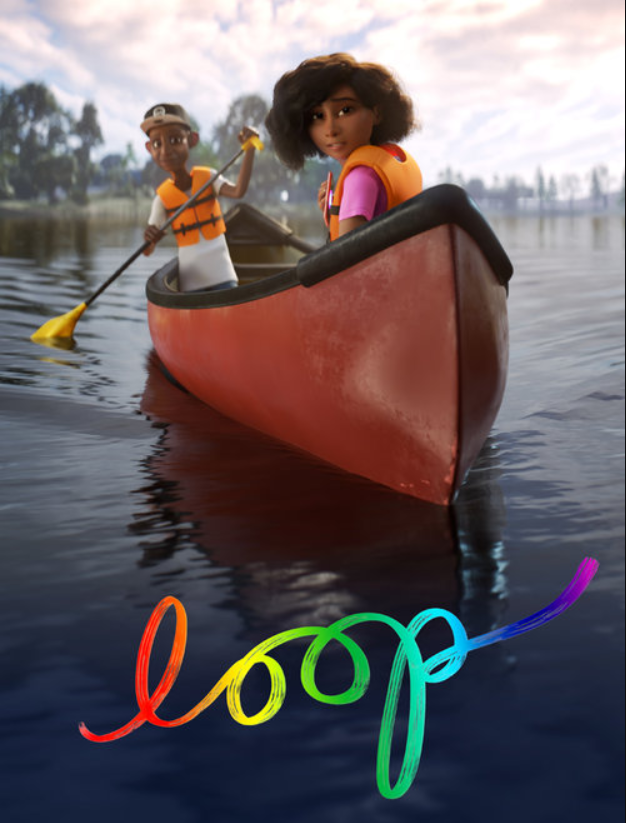
Pixar's SparkShort "Loop" is uncomfortable, unique, and amazing!


Oh the tears!

Pixar has become a master at telling heartfelt, touching stories that still remain compelling, authentic, and sometimes even funny. And somehow their stories have reached the widest of audiences, generally appealing to all. Their latest SparkShort, Loop, is no exception. Released January 10, this short seems to be the most experimental, the most different, the most important of all the Pixar shorts.

In just a few minutes, Loop tells the story of Renee (a non-verbal girl with autism) and her canoe trip with Marcus (a teenager who is less than excited to ride in a canoe with somebody who makes odd noises and sits funny). On the short loop around the lake, both teens learn something about each other -- and more importantly, about themselves. And so it is with the audience -- we learn about others and ourselves.

Pixar's last SparkShort, Float (see our review here), dealt with the similar topic of autism and the unique challenges that arise from that condition. Only Float was subtle, allegorical, and more along the lines of fantasy than reality. Loop is different, much like autism itself. Loop gets to the point right away, tells the story directly and in your face, and never shies away from some of the harsh realities -- and beautiful truths -- about a person living with autism.

As a father of a son with autism, and as a middle school teacher in a public school where I have students with autism in almost every class, Float hit me hard. Like, I think about it a lot and I literally have flashes of Float when I interact with those who have autism. But Loop hits home on a deeper level. It feels different, and that’s a good thing. At times Loop is uncomfortable to watch. At time it melted me to a puddle of love and understanding. I felt for the individually different struggles Marcus and Renee are going through, and I yearned for them to each make a connection. And the genius of Loop is that in making me feel all the feels, I yearn to make connections in the real world and to bring a little more light and understanding to my community.

Sunday, November 24, 2019

Sparkshorts Review: Float

(Guest Post by Ryan)

Pixar’s newest nearly wordless short, found only on Disney Plus, is relatable, allegorical, and cathartic. Float tells the story of an imperfect father and his imperfect son, who find perfection in their imperfection. Attention to detail is Pixar’s strength, and it comes through in things like the father’s crooked teeth, the son’s windswept hair, and the looks on the neighbors’ faces that simultaneously show both judgment and awe.

Float was written to tell the story of a father struggling with his son’s atypicality, reflective of director Bobby Rubio’s own struggles when his son was diagnosed with autism. But because Rubio chooses to use floating as the metaphor for autism, the short transcends pigeonholing, and can be applied to any number of divergences from what is considered normal. A boy who floats could just as easily be a girl with depression, a man with anxiety, or a woman who is an introvert.

And who can’t relate to the few spoken words in the short, which are so poignantly shouted, “Why can’t you just be normal?!”

At times heartbreaking, at times heartwarming, and at times both, Float encourages those with challenges, and their loved ones, to embrace their uniqueness. Negative challenges are present in any difference, like the boy in Float who might present differently than “the norm”. A child with depression might be chronically sad. A man with anxiety might have panic attacks. A woman who is an introvert might struggle to be a leader. These challenges are inherent, but if we focus on the negatives, they weigh us down, like so many rocks in our backpack.


But Float also teaches us that there is beauty in our challenges. When we embrace and love our whole selves, we gain perspective. Embracing our ourselves -- not in spite of our uniqueness, but because of our uniqueness -- is the key to finding self esteem and mental health. The boy in Float can do extraordinary things beyond the abilities of others. A child with depression might be more empathetic with those that need a listening ear. A man with anxiety might have more concern and care for others. A woman who is an introvert might be the best listener you’ve ever met.

“My grace is sufficient for thee: for my strength is made perfect in weakness. Most gladly therefore will I rather glory in my infirmities, that the power of Christ may rest upon me.” (2 Corinthians 12:9)