Showing posts with label trials. Show all posts

Friday, September 15, 2017

The Beast is Alone; We Are Not

(This post was originally posted on my personal blog in June 2014)


The Doctor and Rose end up on a space base on a planet that should not exist: a planet that is orbiting around a black hole. The crew of the base, out of pure human curiosity, came to the planet in order to discover how that planet could possibly stay in orbit and possibly harness that power. Things start to unravel in the space base as a being that seems to be the devil incarnate, the being from which the legend of the devil emanated from, begins to terrorize the Doctor, Rose, and the crew. He begins speaking to them and digging at their deepest fears. The crew and Rose start to panic at his taunts, but of course it’s the Doctor who brings everyone back to their senses with a speech:

“That thing is playing on very basic fears: darkness, childhood nightmares, and all that stuff … What makes his version of the truth any better than mine? Hmm? Because I’ll tell you what I can see: Humans! Brilliant humans! Humans who traveled all the way across space, flying in a tiny little rocket right into the orbit of a black hole, just for the sake of discovery! That’s amazing! Do you hear me? Amazing! All of you: the captain, his officer, his elders, his juniors, his friends. All with one advantage: the Beast is alone. We are not.”

Just like Satan would, he plays on the fears of every living being. He uses our fears until we feel utterly alone. Those are the times that I feel most vulnerable and weak. The adversary tells me that I’m alone, that I have no friends, that I am not loved, or some other twisted tale. The adversary loves to use half-truths. Yes, I may be alone at this moment. Yes, I may be having a hard day. I may have had a bad day at work. I may have failed a test (thank goodness I’m not in school right now).

But even if those things are true, what makes his version of the truth any better than God’s? The truth, the better truth, is that God loves me. God knows I am of infinite worth. God sent His Son to suffer for me because He loves me. God is my Father. God wants me to be close to Him. God cares for me. God will always do what is best for me.

I don’t know about you, but one of those stories sounds a lot nicer and happier than the other. If I focus on the negativity of Satan, darkness will fill my life, but if I will listen to the light of the Savior and to the Spirit, He will bless me with truth, comfort, and love. I’ve seen this in my life and I know it to be true. The Savior loves me and He will always be there for me.


Satan is alone. He will always be alone. He will never have a body, a family, or the experience of this mortal journey. He will never be happy. On the other hand, I have a body, I have my friends, I have my family, I have my agency, and I choose to be happy surrounded by those who love me.

Thursday, July 31, 2014

Lessons from Penelope

Over this past weekend I went on a trip to my friend's cabin in Alabama.  We had a blast boating and swimming in the lake.  It was nice to relax and not worry about anything.  We watched a lot of movies and one of those movies was Penelope.  Now, I don't normally like chick flicks because I was spoon fed them by my girl cousins growing up who insisted that I would be forced to watch them by future wives later in life....

Scratch that.  I don't normally like romantic chick flicks.  Chick flicks like Mean Girls are hilarious and awesome.  Romantic chick flicks that reinforce codependency and unrealistic expectations in relationships are not.

Anyway, Penelope is a little romantic but it's more of a whimsy rite of passage for a girl burdened with a curse.  The titular character comes from a long line of proud wealthy families.  One of her ancestors snubbed a servant girl because he was pressured by his family to marry someone of noble birth.  The servant girl got super depressed and committed suicide.  Her mother just so happened to be the town witch and cursed the family that the first daughter born to them would be given a curse of hideousness.  The curse would only be lifted until the girl would be loved by one of her own kind.

Fast forward 4 or 5 generations and we have Penelope.  Penelope is the first girl and she is born with a pig nose.  The mother, who is overly concerned with having a "normal" life and status hides her daughter from the press and keeps her shut in.  At 18 years of age they start introducing suitors who get interviewed behind a one way mirror.  Penelope observes them, asks them questions, and then reveals herself to them where they run away screaming like clockwork.

Every guy runs away up until she turns 25.  Max, actually stays and gets to know Penelope.  They become friends and potential for companionship blossoms.  Penelope reveals herself but Max doesn't run away--not at first anyway.  We later find out why Max runs and it's not the same reason why the other guys run.  Still, Penelope is hurt and decides to head out on her own and live independently from her parents and actually experience the world that she's been shut out from.

The movie loses a little steam at this point but picks back up when Penelope actually reveals her pig face to the world.  The irony is that she is adored by the public.  Her quirkiness is nothing short of endearing and people love her.  A previous suitor is then pressured to marry her because of her public appeal and Penelope agrees.  At the Altar, Penelope sees that she's only marrying him to please her mother and break some curse that she doesn't even care about.

Penelope leaves the altar and goes to her room being stressed out by her mother.  Her mother says, "Don't you want to break the curse?  Don't you want to be loved?"

Penelope responds, "I love myself!"

Thunder rolls and Penelope falls backwards.  She helps herself up and realizes her pig nose has been replaced by a human nose.  Penelope broke the curse because she loved and accepted herself.

Lessons on Love

One of the most important commandments is to love our neighbor as we love ourselves.  I think a big part of that commandment is the part where we need to truly love and accept ourselves as we are.  Penelope came to love and accept herself with the pig nose.  Her love was unconditional and completely sincere.

Ironically, Penelope even misses her pig nose when the curse is lifted.  She came to see it as a part of her that was likable.  Though she has mixed feelings on the curse being lifted, her self compassion remains unconditional and moves on in life.  That's one of the reasons loving ourselves is so important and so difficult.

A few years ago I learned about fears I had that made it really difficult to love and accept myself.  I didn't like who I was because I believed I was someone different.  I had to learn how to love myself again.  I found that as I grow I change and become something new.  When I become something new, I need to learn who I am and get to know me.  I have to do that, if I'm really going to love myself unconditionally with full acceptance.

Lessons on Action

When Penelope leaves the altar she does it for her.  She certainly loves her mother.  She probably even cares for her fake fiance.  But if Penelope stayed at the altar she would have put her mother's need for a "normal life" above Peneolope's need to love herself and having a life that's her own and not her mother's.  Penelope did something painful but for what she believed was best for her.

It's easy to confused self compassion with arrogance or self centeredness.  If we really love ourselves though, we'll do what's right for us despite the pain.  Taking a shower everyday because you want to be clean and even going to the gym (even if it sucks) can be a a way you show love to yourself.  If you value you, you'll take the medicine and you'll do what's right even when it hurts or isn't convenient.


Lessons on Curses  

We all have them.  We have trials.  We have stuff that makes our life hard or unique.  For Penelope, she had a pig snout.  For one of us, we may have cancer, a difficult addiction, a terrible loss, or even experience same sex attraction.  In the weight of our curse, we may not see it for the potential of the blessing it can be in our life.  When Penelope saw that no one really cared that she had a pig nose it allowed her to be in a place to consider that maybe being "cursed" with a pig nose wasn't so bad.  In fact, it was actually a good thing.

When a boy hears Penelope's story he thinks the moral of the story is, "It's not the power of the curse - it's the power you give the curse."  Our trials can definitely be challenging experiences but they can also be empowering when we start to see them in a different light.  We have power over what can bring us down or "curses" us.  How we go about taking power back from our curses (in healthy ways) and learning from them is a different story on its own.


I'd definitely recommend seeing Penelope.  It's a cute movie with a lot of heart.  Thanks for faithfully following us here on Mormon Geeks!

-Stephen

Friday, September 20, 2013

Tolkien's Great Eagles

Gandalf rescued from Orthanc

Greetings.

Recently I've been pondering on the Great Eagles of Middle-earth, those divine birds who show up at the last minute to save our heroes from destruction, whether it be Bilbo and his dwarven friends in The Hobbit, Gandalf atop Orthanc in The Fellowship of the Ring and after his battle with the Balrog, or Frodo and Sam in The Return of the King. The existence of the Eagles raises many questions, particularly:

1. Why would Tolkien use such a deus ex machina, and multiple times?

2. Why couldn't the Eagles simply fly Bilbo and the dwarves to the Lonely Mountain, or Frodo and Sam to Orodruin?

But before we can explore these questions, some definitions are in order.

First, deus ex machina. It's Latin for "god from the machine," and the term comes from Greek and Roman theater. A deus ex machina is "a person or thing (as in fiction or drama) that appears or is introduced suddenly and unexpectedly and provides a contrived solution to an apparently insoluble difficulty."

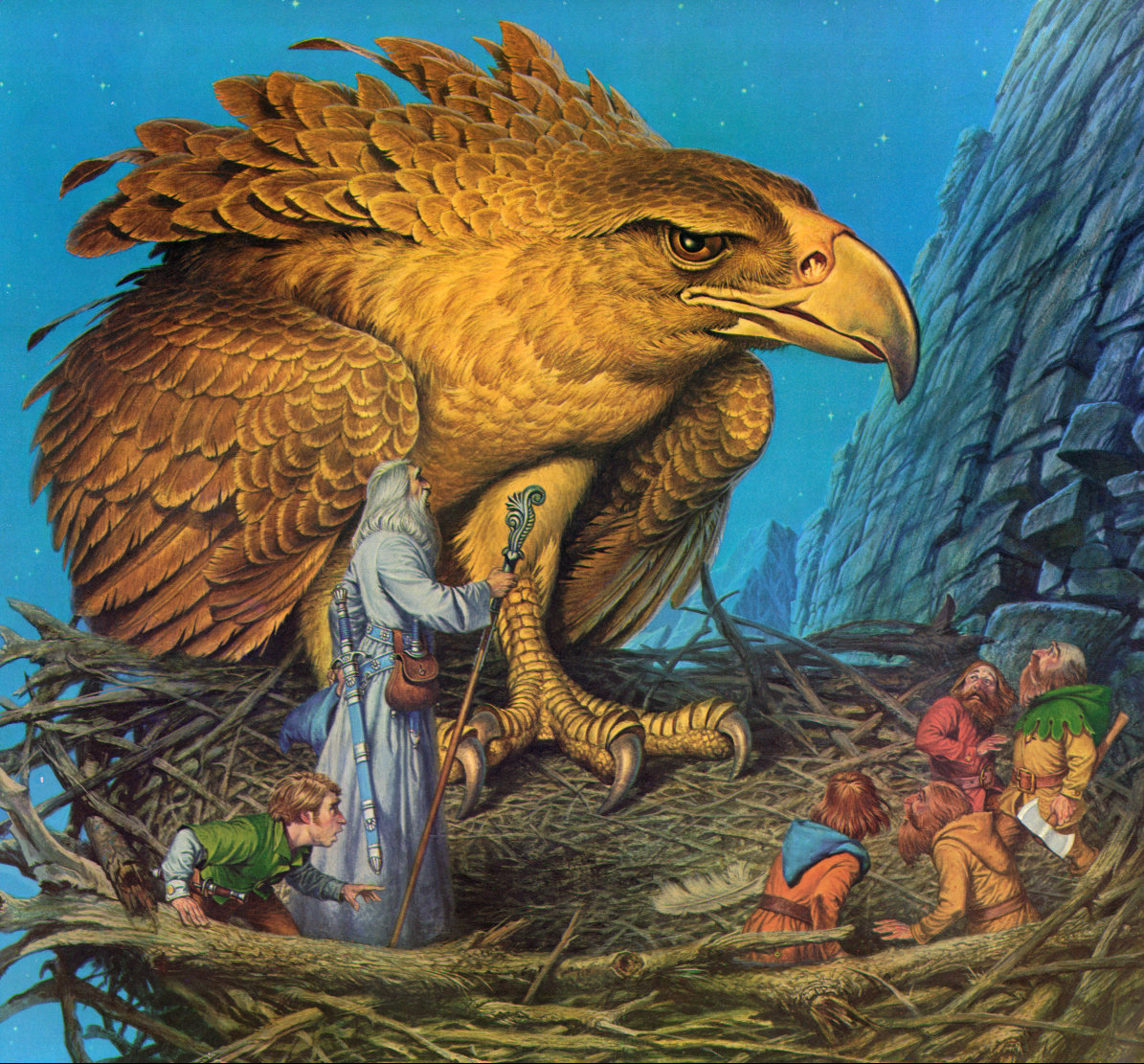
"The Lord of the Eagles" by Darrell Sweet
The first time the Eagles appear in Tolkien's literature, in terms of publishing chronology, is in The Hobbit. Here we see the greatest divide between book and film. In the book, the Eagles suddenly save Bilbo and the dwarves from a band of goblins who are attempting to burn and smoke the heroes out, but this happens at around the 35 percent point of the story. By the time the heroes move on from the Eagle nest, we've nearly forgotten the deus ex machina. The book moves on. The film version has no such luxury, since the heroes are saved by the Eagles at the final climax, and we must wait until the next film for the story to move on. Of course, the viewer has seen the Eagles before in The Lord of the Rings, since this film is cinematically a prequel, but ending one episode of the story in such a way is still irksome to many viewers.

Additionally, I don't believe the Eagles function as a complete deus ex machina in The Return of the King. At least not in the same way they are used in The Hobbit. I say "complete" because, while the Eagles do save Frodo and Sam from a fiery death rather suddenly, this is frustrating because of question 2 above, not because the Eagles resolve the main plot, which they don't. The question was: why couldn't the Eagles have flown Frodo to Mt. Doom in the first place? More on that question later. I also think the Eagles in The Return of the King are not a frustrating deus ex machina because we've encountered them before. Their existence has been set up, therefore they don't fly completely out of the blue.

The second necessary definition: the Great Eagles. Not much exposition is given on them in the films. You could read the Lord of the Rings wiki definition, but there's a lot of Tolkienese. Essentially, the Eagles of Manwë are divine creations who were sent to Middle-earth to keep an eye on the forces of darkness, specifically on Melkor, who was banished from the Undying Lands and whose darkness and power surpasses all others, even that of Sauron. (1)

The Great Eagles function as angels, with the role of watchmen. But again, why would Tolkien employ angelic figures to save the heroes when things get too tough? Isn't this just a cheap trick? Tolkien, not only a master of language but also widely read, had to have known this oftentimes frustrating plot device and the effect it had on readers.

In fact, Tolkien mentions the Eagles in a letter to Forrest J. Ackerman in 1958. The letter was in regards to a movie script treatment adapting The Lord of the Rings, and Tolkien was displeased with many aspects of the treatment, namely the use of the Eagles to fly the Fellowship to their destinations. (Obviously the script writers felt the same way many readers do: if the Eagles exist, why can't they be around to help more often, since they are ever so useful?)

Said Tolkien:

The Eagles are a dangerous "machine." I have used them sparingly, and that is the absolute limit of their credibility.

And later:

"Nine Walkers" and they immediately go up in the air! The intrusion achieves nothing but incredibility, and the staling of the device of the Eagles when at last they are really needed. It is well within the powers of [film] to suggest, relatively briefly, a long and arduous journey, in secrecy, on foot.

We can glean a few things from Tolkien's words:

1. Tolkien was aware of the Eagles as a device, or "machine." (Remember: "god from the machine.")

2. Tolkien uses the Eagles sparingly because he himself thought they were borderline incredible.

3. The answer to one of our questions: the Eagles didn't fly Frodo and the Ring to Orodruin because "secrecy" was important. Sauron could not know where the Ring was, and you can bet he had his Eye on the sky; being chief lieutenant of Melkor, he must have known of the existence of the Eagles.

4. The journey of the Fellowship, their trial, was more important than an easy quest.

And the latter is where I've been trying to get to with this post (it's been a long, roundabout, unexpected journey, I know).

This belief in the power of the journey or trial is common among many people, particularly Christians. It connects to what the Apostle Peter calls "the trial of your faith" (1 Peter 1:7). Also, Mormonism specifically teaches, "Ye receive no witness until after the trial of your faith" (Ether 12:6).

While the Eagles may indeed be examples of deus ex machina, perhaps Tolkien's reasons for using them the way he did was, again, function: the Great Eagles are the "witness," the "joy unspeakable" (1 Peter 1:8) that comes from faith, from facing the trial head-on, from our heroes doing all in their power until there's nothing left.(2)

Although there might be no way to know for sure, I believe this power of the trial was Tolkien's purpose for using the Eagles the way he did, saving our heroes when they had been stretched to their limits.

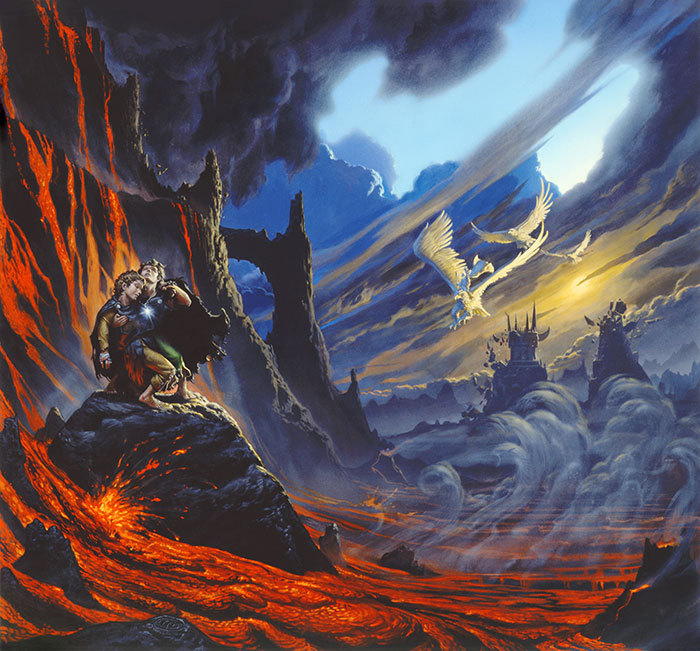
"The Eagles Are Coming" by Michael Whelan
And timing is everything. The Eagles often show up at the last possible moment, with Frodo and Sam's encounter being the most poignant—and, again, the Eagles are less frustrating here than in other instances. Yes, the Eagles save them from death, and the reader/viewer has forgotten about the Eagles, which makes it feel like a "tricksy" plot device. But the Eagles don't show up until after the central climax, the destruction of the Ring. The main quest has already been completed; Frodo and Sam have already saved Middle-earth. In a sense, what happens after the Ring is destroyed is just nice denouement—it wouldn't really matter, from a story standpoint, if Frodo and Sam died on the mountain, although it may be less impactful or cathartic. The Eagles don't fly into Orodruin to make sure the Ring falls into the volcano, nor do they keep Gollum from doing all he can to retrieve it for himself. This falls on our characters' shoulders.

The Eagles also don't come until after Frodo has faced his darkest moment in the entire story, when he decides to take the Ring for himself. Yet, he overcomes this weakness because of Gollum, the Ring is destroyed, and only then do the Eagles save him and Sam from ruin.

But saving Frodo and Sam isn't the only mission of the Eagles there, at "the end of all things." They've come because Gandalf, Aragorn, and company are fighting outside the Black Gates (notice how the Eagles always show up near Gandalf, who has a strong connection to the "divine"). And they will lose this battle, just as Frodo and Sam have no hope for survival. Yet, the Fellowship faces their doom, the trial of their faith, head-on anyway. It is then, and only then, that the winged watchmen arrive.

Such divine intervention is often true in our lives. Sometimes we are deeply mired in personal hardship, and we're blind to any light at the end of the tunnel. When we are stretched to our thinnest, just when we're about to give up, is often the moment when we learn the purpose of the trial, the moment we find the hope we've been looking for. That's when our own Eagles, the divine helpers, show up.

And isn't this metaphor for personal difficulty worth the deus ex machina?


Notes:

1.  Does Melkor's story sound familiar? The Silmarillion, in which much of this takes place, is possibly the most allegorical of Tolkien's work. Gods, creation, a banished brother. But most of the events and characters within The Hobbit and The Lord of the Rings are not quite so obvious in their metaphor. Tolkien didn't care for 1-to-1 metaphorical relationships. In fact, one of his few criticisms of his friend C. S. Lewis's Narnia series was the direct allegory of Aslan as Christ. The contrast in Middle-earth is apparent, with multiple characters exemplary of Christ: Aragorn as the lowly man destined to be king, Gandalf the White as a resurrected being capable of banishing evil spirits, Frodo as bearer of the burden, and even Samwise as friend and bearer of Frodo. But the character metaphors aren't meant to be antitheses to Aslan. The function of this is the idea that we all have Christ within us. And function is everything. Particularly with the Eagles.

2.  Notice also the use of "fire" in 1 Peter 1:7—"though [your faith] be tried by fire"—and the fire preceding the Eagles' saving Bilbo and company, the burning trees in Isengard with Gandalf on the tower, the fiery Balrog and Gandalf's being saved after facing it, and the fires of Doom faced by Frodo and Sam. Not to say this was intentional on Tolkien's part (who knows?), but an interesting connection nonetheless.

Monday, May 20, 2013

My Preshuss


As you more than likely don't know, unless you're my Facebook friend, I recently found my lost wedding ring. It'd been missing for almost three months. These past three months, ironically enough, have been some of the most trying. Even having issues within my marriage. Not because my ring was missing, but somewhere, in the back of my mind, I hoped that if I'd find it, that all I was going through would be done and I could be happy again. Gotta be honest, finding my ring was one of the happiest moments I've had.

And to be honest, I kept thinking to myself, I should pray to find it. Well, of course I should have done that. But instead, I told myself two lies: 1) It's already gone, there's no hope in finding it. And 2) Heavenly Father just doesn't care. Good thing I was wrong. I finally decided to pray this Monday and ask for it to be found; I just wanted it back. While cleaning up something, I went to retrieve some items which had fallen between my nightstand and the wall. This wall has a nice hole in it (with a cover that never seems to want to stay put). Well, when I removed the fallen items, I saw in the hole, and lying there was my ring. I was so excited, but my arm was too fat to reach. So I called my wife into the room, told her to look into the hole and she was happy to see what I'd seen.

So, there's the "Mormon" part of the post. Now to geek it up some.

I was trying to think of some places where rings are prevalent to a plot in all of Geekdom. But then I somehow started thinking of an episode of a television show where a necklace had something special about it. So I'm going to go from a ring to a necklace.


One of my favorite TV shows is Eureka. From its humorous look at sci-fi to its point that knowledge and wisdom are not the same thing, Eureka was a very well-rounded show. About halfway through its run, one of its main characters (Nathan Stark) was killed off saving the town, something that redeemed his obnoxious character.


But the day he died was the day he was supposed to get married to Allison Blake.


Shortly after his death, Sheriff Carter gave Allie a present Nathan wanted to give her on their wedding day.

This necklace, though seemingly just a symbol of their love blah blah blah, it was also empowered with a special diamond. When Allie touched the necklace Nathan would appear and speak to her. For her, this was a way to say goodbye (as she was not around when he died).

This necklace was special as it gave Allie a piece of Nathan and a reminder of the love they shared. Yeah, kind of a mushy tale, but you know what, finding my ring again put me in that kind of a mood.

Alien abductions are involuntary, but probings are scheduled.

Thursday, April 18, 2013

A New Kind of Kryptonite

Recently I’ve been juggling a lot with school, personal progress, and extra curricular activities.  I wrote a post for another blog that I contribute to that spoke of some very vulnerable feelings.  I’ve been doing a lot with my life that I am definitely proud of.  My friends old and new tell me that they're proud of me and that I’m amazing or remarkable.  I believe them and I truly feel that confidence within me.


And because I’m human, I’m feeling pressures to be perfect.  I’m feeling pressures to be an unstoppable superhero.  Even in writing this vulnerable post I spoke of I saw how I was striving so hard to be someone I’m not.  Trying to be a better version of me to the point of putting so much energy into it that I’m wearing myself out.


I really wish I was better than I am.


Last night I prayed for and of a lot of things.  I started crying because I wanted impossible things in my life.  I wanted things that are mutually exclusive to the plan of salvation.  I felt shame in the desires of my heart.  I felt shame knowing that even in these contrary desires I can’t help but feel goodness and spirituality.  I can’t even call them evil because it doesn’t feel right to me and yet anything that is unable to coexist with our Heavenly Father must be.  This also troubles me.


I feel like Superman with a new kind of kryptonite.  He still can fly, is invulnerable, and yet he finds himself unsure of this piece of krypton.  This piece of his origin planet doesn’t bring him to his knees.  He feels drawn to and likes this kryptonite.  But it’s far removed from a place that no longer exists and makes Superman miss his origin planet, a planet he never knew.  This kryptonite takes away from the joy he could be experience on his home planet, earth.


I didn’t come away from the prayer with any answers.  I’m still just as clueless as how to fight out of my trial and resist the strange power of this unknown kryptonite.  But I came away from my prayer knowing the I am a son of my Heavenly Father who loves me.  In the dark time of my life He’s just told me, “Stay close to me.”  He loves me despite my weaknesses because I’m His son.  He would want me to enjoy my life even when in trial.


The big step for me to enjoy my life in the storm isn’t to have the acceptance of others, I have plenty of that.  It’s not just remembering how much my Heavenly Father loves me.  The step I’ve been struggling to take is accepting and loving myself despite my weaknesses simply because my Heavenly Father does.


So here I am seeing that, yeah, I got some stuff I don’t understand.  And right now, I don’t need to. That understanding will come in time.  I know that I’m doing everything I possibly can.  My Heavenly Father wouldn’t want me to get down on myself because I’m not meeting some expectations I’ve held myself to.  He would want me to accept me where I am as I am and just keep moving forward and staying close to him.


Photo credits by Rob Johsnon.
It’s then at that point that I stop worrying and start enjoying.  That’s when I start finding joy even in my endurance of whatever it is I’m facing.  Children exemplify this beautifully.  A child could come out from the wreckage of a tornado.  He’s sad because his home is in ruin.  The neighborhood he remembers is gone.  He may even be afraid of the future with it’s uncertainty.  Yet as he walks through the rubble there he sees a slightly dirty bike.  It’s still in good condition and survived the disaster like he did.  With a joyous laugh the child jumps on the bike and he finds joy despite his trial.


Too often I forget to seek after this joy like this little boy.  If I want to find joy despite my struggles, I need to take a break.  I need to let myself find joy in the company of family and good friends.  I need to draw, design, be creative, and do something spontaneous.  What I’m discovering about this new kind of kryptonite is that only has the power that I give to it.  It doesn’t need any more attention than what is necessary.

I know that we can find joy even in trial.  I know part of that is accepting ourselves as we are in whatever place we find ourselves in.  We don’t justify unrighteousness but we don’t shame ourselves either.  We love and accept ourselves as the savior does.  Thanks for reading everyone.  I know I talk a lot about trials but hey, nobody is perfect.

-Stephen

Tuesday, August 7, 2012

On Fear

With my upcoming GenCon trip, I've noticed that I have a lot of anxiety about going on a trip that's nearly on the other side of the country.  Don't get me wrong, I am quite excited about going to Gencon.  I just have some fears about going.

I've heard once that all fears can be put into one of two categories: fear of the unknown or fear of what we can control.  For instance with my upcoming trip, some unknowns could be what the people I'm going to meet will be like, what kind of food I'll be eating, or even the layout of the convention center.  Some things I couldn't control would be if the plane crashes, if the bus crashes, or if it rains.  Most of those are just examples but you get the idea.

I decided to do a little research on fear.  Fear is actually different than anxiety.  Fear has a definite or certain external 'threat' of some sort.  Anxiety generally lacks that although the responses to fear and anxiety are the same, fear can be much easier to resolve because the problem is more immediate.

Fear (and by relation, anxiety) is actually a learned behavior.  Fear is generally acquired after a person experiences a traumatic event of some kind.  For instance, if a child falls down a well, the child could develop a fear of wells, water, heights, or even enclosed places.  In one case, an experiment was performed in which an 11-month old boy was conditioned to fear a small white puppy.  The fear even became generalized so that the boy would fear anything small, white, and fuzzy.  This even included cotton balls! (see here for more information on that)

I am reminded of a creature from Harry Potter called the boggart.  The boggart was a shape shifter that would turn into whatever a person into what a person feared most. (See here for more)

When a person is exposed to a stimulus associated with fear, their body will begin to produce hormones that prepares the person to either fight what they are afraid of, or to run away from it.  This is often referred to as the 'flight or fight' response.  Fear is typically viewed as a survival response to situations.  There actually are conditions where a person will totally ignore fear.  One example is a parent defending their child from a large predator.  Most parents would put themselves in mortal danger in order to protect their children.  This is considered to be an altered state of being.

To speak on a personal note, I have felt fear over a great many things.  I've felt fear about grades, meeting new people, going places, and travelling.  I've even mentioned my fear of being 'stuck' in a previous post.  Most of the times, what I feel is anxiety.  I've found that there are ways to deal with anxiety.  One of them is to stop thinking about what will happen and focus on what is actually happening around me.  Most of my anxieties are caused by trying to predict or forecast the future.  Focusing on the present helps to dispel my worries about the future.  I can deal with things as they come up.

In closing, I'd like to share some quotes about fear.

"Fear is the path to the dark side.  Fear leads to anger.  Anger leads to hate.  Hate leads to suffering." - Yoda

"Courage is resistance to fear, mastery of fear, not absence of fear." - Mark Twain

“You always fear what you don’t understand.” - Batman Begins

(additional source for this article: Wikipedia)

Friday, May 25, 2012

When the Staff Shatters

(Guest post by Jeff Bennion)
There is a fantastic scene in the final installment of the Lord of the Rings trilogy when the wizard Gandalf comes face-to-face with a Nazgul (the Witch King of Agnmar), who has been terrorizing the city of Gondor. He raises his staff to challenge the Nazgul. The Witch King throws off his cloak to expose his crown of fear and raises his sword of flame. With the barest of effort the Witch King shatters Gandalf’s staff.
Gandalf is taken aback, momentarily stunned. He has wielded his staff to thwart much evil and destruction, it is the repository of much power. But it fails him here. What will he do next? Will he just crumple up and die, as the Witch King says he is about to?
No, he doesn’t. Taking advantage of the arrival of the cavalry from Rohan, Gandalf gets up and continues to rally the citizens of Gondor to the defense of their city, exhorting them to hold strong in the defense of their city, even in the face of a terrifying and merciless assault.

I have a friend, and I wish he was the only one, who recently decided to leave the Church and forsake his covenants after yet another dating relationship ended. He had put all his faith and hope in himself happily married with children, and after this particularly painful breakup, he lost that faith. It had happened too many times before for him to keep the hope that it wouldn’t happen again. He didn’t want to remain single in the Church the rest of his life, and he had no remaining hope that he could be anything but that. His staff shattered. He had a choice then. I could pick himself up and fight on with what remained, or he could say, “Well, that’s done for then. I’m outta here.”
This is just one example of many I could choose. There are people who go off the rails after a divorce, or after the physical or spiritual loss of a child, or after a financial disaster. There are those who leave after being gossiped about and lied about. None of these things are fair, or deserved.
The tragedy, of course, is that my friend’s desire to be married and have a family were good things. So is reading our scriptures, having regular meaningful prayer, studying the words of the Prophets, obedience to the Word of Wisdom, the Law of the Fast, the principle of tithing, and so on with the many wonderful gospel principles. But none of these, not even all of them together, is always going to work They cannot prevent misfortune, death, disease, emotional torment, isolation, or failure in any of its many forms.
My title here isn’t if your staff shatters, but when. I believe each of us will be faced with a moment (or perhaps more than one moment) like this. We are told that good is stronger than evil, and that good will prevail. I believe that, not because of any preponderance of evidence, but because I choose to believe it. There will be times when good won’t look stronger than evil, where what in the past you have used with much success will shatter and have no effect. I say this because this has been my experience. It is at this point when enduring and continuing adherence to the gospel will not seem like the sensible or logical choice. That is when I faced my greatest choice. Will I continue, diminished, to fight on the losing side, or will I switch sides and try to negotiate a separate peace?
Faith is a power, but before it has any power for us, it is a choice. And that is where its greatest power is as well. Choice is the only thing we have true power over. We can say yes or we can say no. Such a little thing, but it makes all the difference. Faith means choosing the good even when evil is vastly stronger. Faith means fighting on even when the cause is lost. Faith means picking yourself up and fighting on even when your strength and power have failed you. It is insisting, against all evidence to the contrary, that there is light, even when all around you is darkness.
What is your staff? What would you do if it fails you in your hour of greatest need?
You can see the scene I refer to here. Note to Tolkien geeks: I am aware that Gandalf’s staff shattering and momentary collapse isn’t in the book. For the reasons elaborated above, I like Peter Jackson’s movie portrayal anyway.