Wednesday, June 8, 2022

3 Idiots: A Must Watch

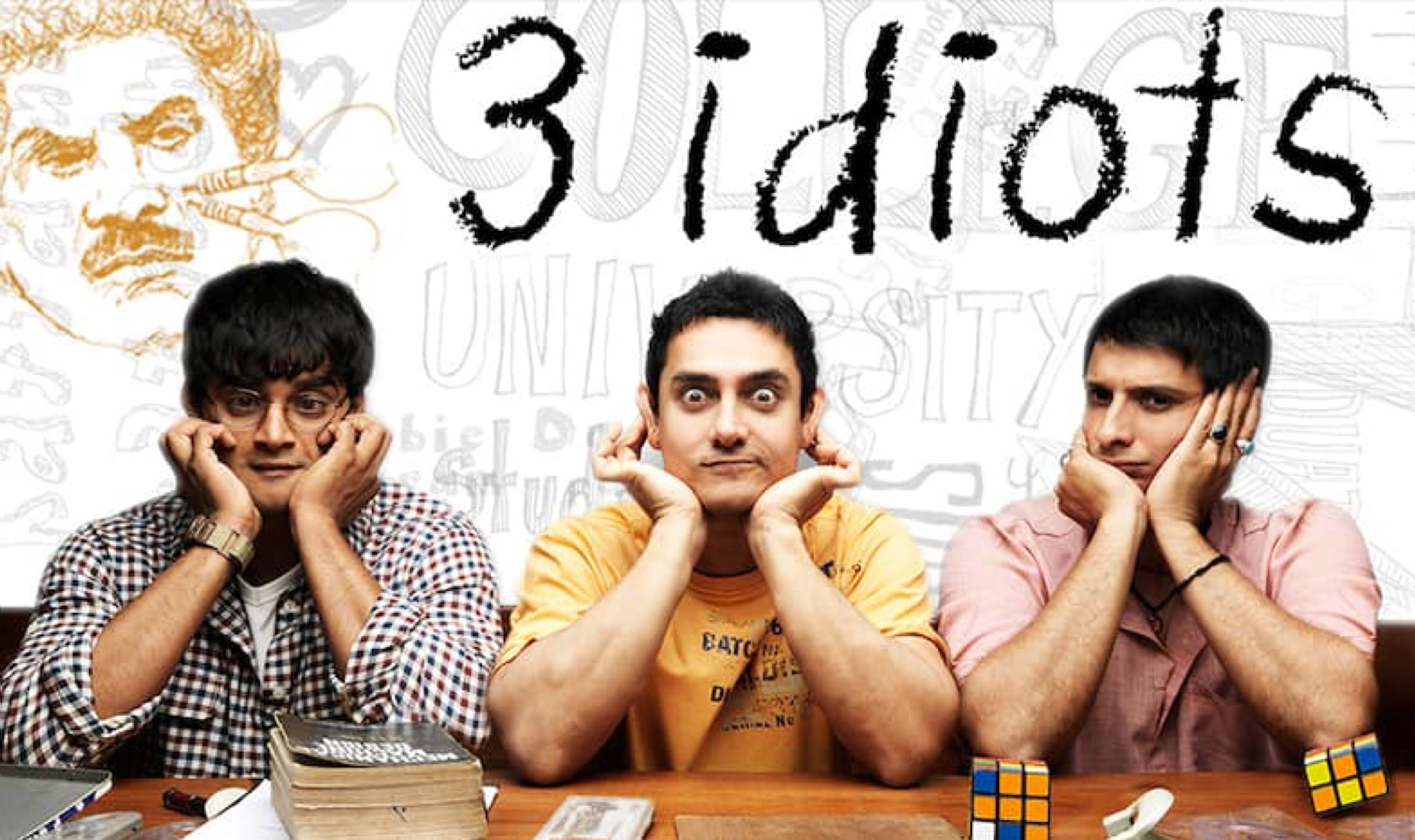
I have never seen a Bollywood movie, and this past weekend I experienced my first. 3 Idiots available on Netflix is a coming-of-age comedy made in 2009. The movie focuses on three students (Farthan, Raju, and Rancho) getting educated in engineering at a prestigious college. Each character is relatable. Farthan is a passionate photographer but is getting a degree in engineering to appease his father; while Raju likes engineering, but has anxiety because if he fails he wouldn’t be able to support his family, therefore he lacks self-confidence; and Rancho is passionate about engineering and approaches the subject in a different way. Initially I thought this movie would be Bollywood version of three stooges, but I was wrong. This is its own movie, and everything was executed perfectly. I just wish I knew some information before I watched this movie.

The first thing I wish I knew is that the audio was in English and Hindi, meaning that they switch between both languages. Unless you know Hindi fluently subtitles is a must. I didn't have any problem having subtitles on, I usually have it on no matter what the movie because I retain more dialogue. 

The next aspect I wish I knew was the movie's runtime was close to 3 hours, and half way through the movie I thought it was close to the ending. I was so glad that I was wrong. It could have ended early, but the second half of the movie made it a must watch. up to the half way point we see the main trio develop and have gone through some climax, but there is no rule of thumb that fictional characters can go through one and only one climax. I am so happy how long the movie is and I wouldn't cut anything out of it.

Last note that I wished I knew before watching is most of the movie takes place in a flash back, sometimes a flashback of a flashback. I thought that the first half of the movie would be a flashback, while the later would take place in the present, but I was wrong. majority of the movie takes place in a flashback, while the trio were in college. With all that being said lets transition and discuss the art of the movie.

Chekhov’s gun is a dramatic principle that states if a play shows a gun in the first act, then it must be used during the second act. "One must never place a loaded rifle on the stage if it isn't going to go off. It's wrong to make promises you don't mean to keep." Chekhov, letter to Aleksandr Semenovich Lazarev. Recently, we have been seeing this violation occur in movies such as the new trilogy of Star Wars. In episode seven we are teased that snoke is the powerful adversary, but then he is easily killed off in the following movie, diminishing him being a threat, misleading the audience. There are more sins from the newest Star Wars movie, but this isn’t about Star Wars. In 3 Idiots Chekhov’s gun was beautifully done. There were so many nuggets that were brought up in the beginning and fulfilled later. What amazed me was I thought some of these guns were character development and and wasn't expected it to be brought up again, but when they did it was a delightful surprise.

It's wouldn't be a Bollywood movie is there wasn’t a musical number during the movie. This movie had two musicals both upbeat and chessy in the best way possible. The first one is called “Aal Izz Well” (all is well) and the other was “Zoobi Doobi”. Out of the two musicals Aal Izz Well is may favorite. I think I related to this one more since I am still a student, and it was catchy. The meaning of the song is to not discourage us when we are going through hard times because even when its hard all is well. “Zoobi Doobi” is a love song about falling in love for the first time and how crazy it is.

Even though this is a comedy it doesn’t stray from discussing difficult topics, such as suicide. On three (technically four) occasions suicide was brought up. I won’t mention what happens because of spoilers, but the messages were clear. Suicide is not an answer. There will be people that miss you, need you, love you. A life is more important than the reason you feel like you can’t live no more. Remember the worth of souls is great in the sight of God (D&C 18:10-11). I think that suicide is a heavy subject to discuss and they did not joke about it or lighten it.

One of my favorite scenes of the movie is when the 3 idiots are hungry (poor college students having a bad day) and couldn’t find or afford any food, so they sneak into a wedding they walked by, pretending to belong, and loaded so much food onto the most unrealistic massive plates and got caught by none other than the antagonist of the movie, the director of the college, Virus. By some chance they crashed his daughter’s wedding, and he mercilessly reprehends them in a comedic way.

If you haven't seen a Bollywood movie, give 3 idiots a try. You will laugh, Aal Izz Well will get stuck in your head, you will enjoy the overall message, and you will relate to the characters. Don't miss out on trying something different. I regret that it has taken me this long to see my first Indian film.

Monday, June 6, 2022

Thor Binge List


Another month, another Marvel countdown. This time we’re looking forward to the fourth Thor movie: Love and Thunder. If you haven’t watched them recently, I recommend looking back through some of the major movies leading up to Thor’s new adventure

Thor

Though some scenes from Loki might dispute this, the first Thor movie was our hero’s first adventure to Midgard. It’s definitely the first time he met Jane Foster and SHIELD. And thus began his association with humans as a superhero during his banishment to Earth. Unfortunately this association was cut short when he was forced to destroy the rainbow bridge. 

The Avengers 

As Loki schemed his way to Earth during the Thor credits scene and into the beginning of this movie, Thor had to find a way back to Earth to stop his adopted brother. After a brief skirmish with the fledgling Avengers, Thor teamed up with our heroes to save New York (and Earth) from Loki and the Chitauri. And with that, Thor returned to Asgard with Loki in custody. 


Thor: The Dark World 

This might be the Marvel movie that gets the most flack. That being said, I still enjoy Dark World. And, as we’re being reintroduced to Jane Foster next month, we should look at her last appearance (her cameo in Endgame doesn’t count). We left Jane Foster locking lips with Thor after defeating the Dark Elves. We thought we’d see more of Jane and Thor’s relationship, but that was not to be.

Guardians of the Galaxy 1-2 

Since the Guardians are set to appear in Love and Thunder, we’ve gotta revisit their beginnings in these two movies. As a hodge-podge group of fugitives just out to get some cash, we ended up seeing these heroes-to-be join forces to save Xandar from Ronin and the Power Stone. Being exonerated for their heroics, the Guardians of the Galaxy basically became heroes for hire. After getting into some trouble with the Sovereigns, they were rescued by Ego, Star-Lord’s father… only to end up fighting him as well. That’s just par for the course with them. 


Avengers: Age of Ultron

Back on Earth to help the Avengers (and probably to visit Jane), Thor raided a Hydra base (thanks for that intel, Agents of SHIELD) and, as they celebrated, Tony created Ultron. Facepalm. But it is what it is. In the process of fighting Ultron, Thor gets inadvertently sent chasing after Infinity Stones. Which leads us to the next movie…

Thor: Ragnarok

A complete change in tone compared to the first two Thor movies, but we got the God of Thunder teaming up with his brother, Bruce Banner/Hulk, and Valkyrie to escape a gladiator planet and save Asgard from Hela, Thor’s long lost sister and Goddess of Death. But instead of saving Asgard, Thor evacuated his people and destroyed his home. So all was good… until Thanos’s ship showed up.


Avengers: Infinity War

With the Asgardians’ ship half massacred, Bruce Banner was sent back to Earth to prepare the Avengers for Thanos’s arrival. Meanwhile Thor was found by the Guardians of the Galaxy. As both groups tried to beat Thanos to the Infinity Stones, battles occurred on multiple fronts. Unfortunately, even as Thor, Rocket, and Groot joined the fray in Wakanda, the Avengers on Earth and on Titan were unable to stop Thanos. And there went half the universe…

Avengers: Endgame

With Thor depressed and drunk most of the missing five years, it was a struggle dragging him out of retirement (if you can call it that) to help undo the Snap. Having found some closure with his mother’s death during the Time Heist, Thor was one of the leading forces as the Avengers took down the Mad Titan. Later, after Tony’s funeral, Thor left Valkyrie in charge of New Asgard. And off he went with the Guardians of the Galaxy.


And with the finale of Phase 3, you’re caught up for Love and Thunder. If you want further viewing, maybe check out Lady Sif’s other appearances in Agents of SHIELD (episodes 1x15 and 2x12) and Loki (episode 4). There have also been rumors about Loki 2.0 showing up, so now could be a good time to rewatch Loki on Disney Plus.

Friday, June 3, 2022

D&D Class Breakdown: Monk

For new players, it can be hard to choose your first class. For veteran players, it can be hard to choose a class and not fall into stereotypes everyone's seen a thousand times. So now I'm going to deconstruct the 5E Player's Handbook classes (Sorry Artificer, you'll come later) and talk about what works, what doesn't, and some interesting ways to play the classes. 

I won't be going into game mechanics as much as I'll be going into roleplay. 

Let's talk about monks!


...This is going to get ugly...

What is a Monk? 
The word monk is itself problematic. Used to describe the monastic traditions of various Asian cultures, monks represent the belief of reaching a state of enlightenment by tempering and perfecting one's own body. The English word is derived from the secluded Christian monks that were the closest word that described the people met in exploration and trade. 


Word etymology aside, the real problematic issues with the monks are that they continue the tradition of mythicizing non-European cultures and their spiritual beliefs. The monk itself in D&D is not just a martial artist, but a martial artist able to gain supernatural abilities through the perfection of their body, even obtaining the ability to become an outsider type in version 3.5. When a culture is perceived as mystic it can be just as problematic as any other form of racism because it misrepresents the people who identify with that culture. 

The traditions the monk is based off of are alive in well throughout the world, so Dungeons and Dragons players need to walk a fine line when incorporating the monk into the game... Which they don't always do...

In the Game
Since most D&D games take place in western medieval fantasy settings, the monk is an odd man out in society. Usually a story will say that the monks come from a mysterious distant land. 

Sound familiar? 

The exoticism of the monk in most games continues to perpetuate the structural racism that comes with the concept of the monk. Because the monk is supposed to be from a foreign land they usually only manifest in the player characters who play them. Rarely will an NPC be a monk unless it's a direct tie to the player's monk. 


So I've been talking a lot of trash about the monk, but let me be clear: I don't think Dungeons and Dragons is racist, nor do I think people who play monks are racist. I think that the monk is part of a bigger problem the game and most western fiction: coding non-western cultures into fiction to use their cultural traditions and beliefs to create exotic others. The reason I'm picking on the monk so much is (A) this is the series I chose to do and (B) with the freeform of Dungeons and Dragons we can use the monk but do better than rip off centuries of cultural appropriation. 

Breaking the Trope

For an example of the monk class done well I'd like to circle the Avatar: The Last Airbender franchise and then go get a cheeseburger, but let me expound on it. Pretty much every bender and fighter person in Avatar is a monk, the difference between them and the problematic monk is thus:  

A: The monks are not tied to one tradition, they are in fact a blending of multiple cultures and beliefs with a lot of homebrewed fiction to create their world. 


B: Except for the avatar, monks in this world are not exotic. They are so commonplace that nearly everyone knows somebody who can bend the elements or has trained in martial arts. 

So how do we break the trope in the campaign? Usually I address the player's creation choices but here I'm going to have to talk to the dungeon masters out there to alter their worlds. 

An Order 
If you want monks in your world, write an organization that specially trains and utilizes monks that is commonplace, even if it is secret or rumor. Make them part of the lore for the land the characters find themselves in, and not a far-off concept in a vague direction. Good starts are organizations like the Foot Clan from Ninja Turtles  and the Black Widows from the MCU. 

Specially Trained Heroes
If you can't fit organizations into your game world, try smaller groups, those who train in a specific way for a specific purpose. The best example here is Batman, who is a master in multiple martial arts to the point where he basically has his own way of fighting. He teaches his Robins the same style, a multi-form combat in capes, and thus in their way they perfect their own martial art style. This removes cultural appropriation from your campaign and adds ripping off Batman to the list of copyright crimes a dungeon master commits on a daily basis. 

A Fleshed Out Land
If you insist on the far-off land option, then flesh out said land. Write the culture, beliefs, the people and the practices of these people. Pick a specific Asian culture and understand its martial arts practices and use it as inspiration. Let the characters be able to visit the land and meet other people like their monk. Keep in mind with this my earlier warning about exotiocising another's culture for the feeling of other. 

Oops All Monks
Consider when describing your world sprinkling monks into the populace more. Make them as relatively common as fighters and sorcerers, this will make the monk less of an exotic oddity and more of just part of the world they exist in. Think about peppering your encounters with monks, either from the books or making your own. This can also give your players an extra challenge in their next fight. 

Famous Monks

Avatar Aang (Avatar the Last Airbender)
Like I said, everyone in ATLA is a monk, unless their a rando monk or Sokka the fighter. Aang gets top billing just for being the first one we get to meet. He also embodies the monk's goal to gain spiritual enlightenment through physical perfection. 


Batman (DC Comics)
Technically Batman is a fighter/rogue/ranger/monk but we'll focus on his monk part. Studying martial arts has given him multiple unusual abilities he uses to fight crime, including holding his breath for an extra long time and meditating for 20 minutes instead of sleeping. This of course extends to his army of prodogies, especially Nightwing who can do a quadrouple jump. 


Master Splinter (Teenage Mutant Ninja Turtles)
A martial arts master, Splinter is a dangerous foe despite his advanced age and being a giant rat. He has focused his mind and his body to be the perfect weapon, but he chooses a path of peace whenever he can. I'd put the Turtles here too, but when I was a kid I always wanted to be Splinter so here's a shout out to my favorite rat. 


Oogway (Kung Fu Panda)
While martial arts is one thing, the key is body perfection to extrordinary ability, like how Master Oogway was able to find his way to ascending to another plane. He was also able to defeat a powerful enemy with just a few touches of his claws, hardly even breaking a sweat like he was programming a microwave. 


-JOE

Check out the other D&D Classes as well: Barbarian, Bard, Cleric, Druid, Fighter

Wednesday, June 1, 2022

Not-So-Boring Board Games

I love RPG video games. A good story attracts me more than anything else, I rather play a heartfelt story than play a shooter game. Some of my favorite RPG games are Final Fantasy, Kingdom Hearts, Legend of Zelda, and Portal. RPG games introduced me to Dungeons and Dragon. My favorite character I created was Tom Underhill, a halfling bard that thought he was a barbarian. However, as I have grown older, I have been had a hard time dedicating so much time into playing D&D. So, I have transitioned into play board games. It’s shorter and allows me to have the social aspect that D&D provides. I may not be able to have as much freedom as D&D brings, but I enjoy board games.

I want to share with you two games that I love that reminds me of Dungeons and Dragons. Both games are cooperative and the more people that play with you the better the experience.

Marvel Legendary

The objective of the game is to beat the mastermind that is trying to take over New York by recruiting enough superheroes to beat that villain. You start off with a small deck of agents of S.H.I.E.L.D. that can help you purchase superheroes (increasing the size of your deck) or attack weak minions. As the game progresses your deck becomes stacked with very useful superheroes that will aid you to defeat the mastermind. The game comes with many superheroes’ cards, and you get to choose a set number of them to help you fight against the mastermind (There are different villains to pick from as well, like Loki, Red Skull, and King Pin). Each mastermind has an objective and scheme that if he is successful, then you lose the game. On the other hand, if you successfully attack the mastermind four times then you win.

I love this game because you can set the difficulty level by choosing a stronger mastermind and weaker superheroes. My favorite superhero to use is the Hulk. He is very strong and helps get rid of wound cards (useless cards in your deck that no one wants). I think I lose most times when I don’t have the Hulk. When I do have the Hulk, I have a higher chance of winning. I like the difficulty being hard because when I win, I feel like a legend!

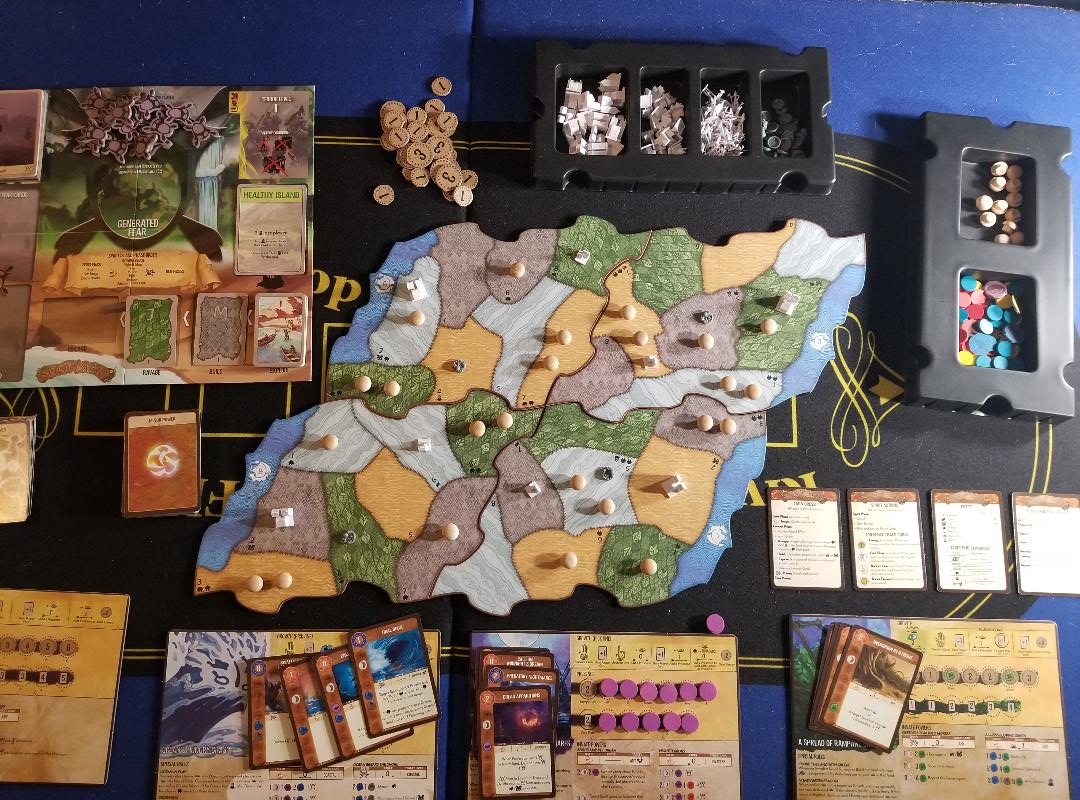
Spirit Island

In the game you play as spirits on an island that is being invaded by explores. Your objective is to prevent new explores from invading. The game comes with different spirits that you can choose to play as, each having their own strength and weakness. As a cooperative team you work together to stop the invaders from colonizing on your island. Certain spirits are elemental based like lightning’s swift strike, river surges in sunlight, vital strength of the Earth, and Shadows Flicker Like Flame. They use their elements to helps them get rid of invaders. So, if you like Avatar the last Airbender you can choose your favorite nation and play as a spirit that corresponds to that nation. There are other spirits that are strengthened by the number of islanders that worship it, while other spirits bring fear to their enemies. Each spirit has a complexity level helping the player know how difficult it is to play as that spirit. The levels are low, moderate, and high.

This is a great game. My favorite spirit to play as is Bringer of Dreams and Nightmares. He as a high complexity level because he cannot attack invaders instead, he brings fear to explorers and drives them out. Creating enough fear is a way to win the game.


Monday, May 30, 2022

Show Yourself

I read once that “Into the Unknown” was meant to be the “Let It Go” of Frozen 2. Maybe that’s the case, but unlike “Let It Go” it didn't resonate with me. Rather, the Frozen 2 song that I connected with more was “Show Yourself”.

The whole movie, Elsa chases this disembodied voice through Arendelle and across the wilderness. With Arendelle in distress and the Northuldra trapped in the forest, she puts it on herself to find the source of the voice. Even forcefully sending her sister and Olaf back as she headed to Ahtohallan. 


As she approaches the ice island, my favorite Frozen song begins. As she approaches the “river full of memory”. She goes through the song, expecting to get the answer to all the mysteries, singing things like “Are you the one I've been looking for” and “You are the answer I've waited for.” Turns out, the spirit she was looking to for answers was herself. 

“Show yourself
“Step into the power
“Grow yourself
“Into something new
“You are the one you've been waiting for
“All of my life.”

How many times do I want a magical fix for my problems? I want this mystical spirit (or maybe even God) to give me an immediate fix to my problems. One session of therapy to fix my depression. One dose of medication to alleviate my anxiety. One prayer to lift my self-esteem. I would have given anything to have a quick fix for my mental health so I could return to my missionary service and finish my remaining 21 months. 


Instead, I’ve gotten the impression that God wants me to put effort in (shocker right?). Real healing from mental illness, addiction, or anything else takes work and patience. I didn’t get to go back on my mission right away. And even when I did, it wasn’t a quick fix. I still struggled. I still had more work to do on myself. 

The Lord has said “For the power is in them, wherein they are agents unto themselves. And inasmuch as men do good they shall in nowise lose their reward.” (D&C 58:28)

The Lord expects us to work. He expects us to act. As Joseph Smith told the saints, “let us cheerfully do all things that lie in our power; and then may we stand still, with the utmost assurance, to see the salvation of God” (D&C 123:17). 


There is power in owning our stories and taking charge of them. We can’t control everything, but we can (as last week’s Come Follow Me lesson said) “choose … this day whom ye will serve” (Joshua 24:15) Coming back to Frozen 2, Elsa didn’t get her power from someone giving it to her. Heck, she couldn’t even make it to her destination on her own until she tamed the water spirit. But after visiting Ahtohollan and fully owning her power, she was able to stop the tidal wave to save Arendelle. She was no longer scared to act. And that made all the difference. 

“For behold, it is not meet that I should command in all things; for he that is compelled in all things, the same is a slothful and not a wise servant; wherefore he receiveth no reward.
“Verily I say, men should be anxiously engaged in a good cause, and do many things of their own free will, and bring to pass much righteousness;”
(D&C 58:26-27)

Friday, May 27, 2022

The Thing About Missionary Service


As I sat in the Mission President’s office, I could see out the window over the field that was across the parking lot. The sun was setting in the distance. It was so beautiful, yet I couldn’t enjoy it. I’d gone to two counseling sessions in the past three weeks and I still felt just as lost as ever about what to do. As I was lost in my sea of thought, my mission president returned to the office after returning from taking a phone call with my counselor.

“Elder Ficiur,” President said, sitting down. “With all this spiritual interference—” he was referring to my mental health problems, “—combined with your Asperger’s, we think that it would be best—” No! No! He couldn’t be saying what I think was about to say. “—for you to take a break from your service and for you to go home.”

The news hit me like a brick. Tears had started coming before President could even finish speaking. “No… no…” I muttered, “I can’t go home.”

Canada Toronto West Mission 2010

I came home from my mission after two transfers, about 3 months. I wanted so badly to be a missionary that I worked for a year after the story above to go back out–Only to come home again after another two transfers. Because of the heart break associated with my missionary service, I’ve developed some strong opinions on the subject. I can’t tell you how many times I’ve had to tune out or step out of Elders Quorum in order to avoid the tears when I heard the words “when I was on the mission”. But as much as I feel the heartbreak still at times almost 12 years later, I have a deep love for missionary work. So when President Nelson and President Ballard spoke about missionary work this past General Conference, I kind of knew this post would happen. 

A Priesthood Duty 

Shortly after General Conference, I saw a post on a Latter-day Saint Reddit page asking if missionary service is a commandment. Talking to a friend recently, I thought about how much pressure the phrase “priesthood duty” can put on young men. A dictionary definition of “duty” will use the words “obligation” and "responsibility" to describe someone’s actions. In contrast, the seminary Doctrinal Mastery document calls commandments “the laws and requirements that God gives to help us progress and become like Him.” A full-time mission is a marvelous and miraculous way for us to progress and become like God, but (as I was gratefully told as I prepared to come home) a mission is not a saving ordinance. I don’t know why this made such an impact on me as an early returned missionary. Maybe it reminded me that I hadn’t diverged from the gospel path? Maybe it was reassurance that the Lord wasn’t upset with me? Either way, missionary service is our duty as priesthood holders, as in our responsibility, but it's not what'll take you to the Celestial Kingdom.

Home from Toronto 2010

Prepare to Serve

I’ve seen the question posed a lot on social media about whether to serve or not serve. What if a person can’t? Preparation for a mission is preparation to consecrate our lives to God. If you are wondering whether you should prepare to serve a mission, prepare. Even if the answer is no, prepare. The spiritual and emotional preparation that goes into serving a mission will benefit you throughout the rest of your life. A testimony of the gospel and the Book of Mormon will strengthen your resolve to live the gospel, regardless of which turns it takes.

Service Missions

I made a friend recently who was honorably excused from full-time missionary service. But because he wanted to serve a mission, he went forward with a service mission. In preparation for this post, he told me that it bothers him when people speak about service missions as though they’re simply a backup plan or less than. No one ever said this to me about my mission, but it was very tempting to look at my short missionary service as a second-class mission. My friend was asked “Why didn’t you serve a real mission?” I’ll be honest, when I came home from my mission I was one of these people… I thought a service mission was beneath me. Looking back, I wish I’d given it more of a chance. I think I’d have learned a lot from a service mission. “Now behold, Helaman and his brethren were no less serviceable unto the people than was Moroni.” (Alma 48:19) Missionary service looks different for everyone. And they all matter.

Canada Calgary Mission 2011

A Desire to Serve

This last point is possibly my most important. The Lord told Joseph Smith, “if ye have desires to serve God ye are called to the work” (D&D 4:3). If you want to serve a mission, go for it! If you don’t have a desire to serve, figure out why that is. If something is holding you back, talk to your bishop or a counselor and figure out what’ll get you there. But like I said, missionary service looks different for everyone. I wanted to serve a 24-month mission… but instead I was blessed with two short missions and four mini-missions at the Hill Cumorah Pageant. I’m grateful for the chance I had to serve, in Toronto, Calgary, and the Hill Cumorah. And someday, with my wife, somewhere new, I’ll serve again. 

Hill Cumorah Pageant 2001, my first mission

Wednesday, May 25, 2022

From Dad Bod to God Bod


(Guest post by B)

“Dad bod” is a slang term in popular culture referring to a body shape particular to middle-aged men. The phrase has been adopted in U.S. culture to refer to a male who was once particularly lean or fit, but over time has gained an excessive amount of body fat, typically around the waist, leading to a "beer belly".  ---Wikipedia

In the recently released trailer for Thor: Love and Thunder, one line from Korg the stone-like Kronan warrior goes into storytime mode with the line “He went from dad bod to god bod.”

This line, while incredibly humorous and relevant in our day, instantly hit me as a reminder of our own individual divine potential.  


As Latter-day Saints we understand that all people are children of Heavenly Parents and have the potential to become like Them (see Acts 17:29; Ephesians 4:6; Hebrews 12:9). The Savior’s admonition to become perfect as He is perfect is an evidence of our divine potential.

Many features found on earth give rise to powerful scriptural symbols. The wildernesses of Jared, Moses, and Lehi symbolize the testing of faith. The thorns and thistles that came after the Fall typify the trials of mortal life. These symbols teach us about the nature and purpose of mortality, but they do not teach us that we should think negatively of the earth. After all, the Lord Himself has declared the earth to be good.

Divine patterns, then, are the processes, fundamental laws, principles, and truths that the Lord seems to follow in ordering and organizing his heavenly and earthly realms. In revealing these divine patterns to his mortal children, the Lord reveals his patterns of truth and righteousness, which, if identified, understood, followed, traced, copied, or imitated, will give us additional motivation to cleanse our souls of earth-stain, crack through accumulated earth crust, and retrace the patterns to our heavenly home.


We can draw three lessons from nature’s grandeur: first, God exists; second, God is powerful; and third, God loves us. One way we can feel a surety of the Creator’s existence is to observe His handiwork. A marvelous way to do this is to gaze into a star-filled sky on a moonless night or to watch the many varieties of summer bee and butterflies on a single lavender bush.  As Alma taught, “All things denote there is a God;”

The knowledge of God’s existence teaches us of His power.

We are keenly aware of God’s majesty and power when we see His handiwork in motion. Next time you stand at the foot of a roaring waterfall or at the toe of a mighty glacier, reflect on the power of the Creator.

The very existence of this earth impresses upon us the reality that God loves us. Our answer may be found in asking another question: how important must mankind be to God, seeing that He has created all of this for us? We are surrounded by signs of God’s love for us.

There are other fundamental lessons to draw from the Creation—lessons of what the Creator might expect from us. By virtue of living upon the earth we shoulder two responsibilities. The first is to care for our beautiful home.


At the Creation of the world God placed Adam and Eve as caretakers, with dominion over “every living thing that moveth upon the earth,” and gave them instructions to “replenish the earth, and subdue it” (Abr. 4:28). The earth, then, was created for us and given into our care. It is within our power to do with it what we like, but since it is God who entrusted it to us, it is to Him we shall answer for what we choose to do.

A second responsibility man owes is gratitude. Gratitude is an essential ingredient in accepting any gift from God.

We can show gratitude by following the second great commandment to “love thy neighbor as they self”

As followers of Christ, we all have a responsibility to create a supportive and loving environment for all God’s children. Such a support network makes it much easier to live the gospel and to seek the Spirit while navigating any aspect of mortality.


So then, how do we put off the natural “dad bod” in us all and become, as Korg put it a “god bod?” We gain an understanding of our individual divine potential. We seek a personal knowledge of our Eternal Father’s existence, His power and His love for us. We strive to follow divine patterns, help others along our way, and do our very best to follow the Savior’s admonition to become perfect as He is perfect.

We are made in the image of our Heavenly Parents, and they don’t make mistakes. As we come to understand those parts of ourselves we don’t initially like, our emotions, fears, attractions, difficulties, or physical imperfections we can take comfort and know we are just as THEY need us to be. 


Monday, May 23, 2022

The Magic of Memory

Amnesia is an old trope in fiction, all the way back when Fred Flintstone was clocked over the head with a frying pan and suffered a football player level concussion. While getting hit in the head and forgetting is usually done for a laugh, when magic is involved the amnesia trope takes a more serious tone. The exploration of memory loss turns from a well timed joke to a timeless message about loss and the space a person makes when they're no longer there. 

Trigger warning: Suicide

"Better if I was Never Born"

Modern fiction sees the first incident of magical amnesia in It's a Wonderful Life when Clarence shows a suicidal George Bailey what the world would be like if he was never born. Not exactly a memory spell but it may as well be. We see that without George Bailey, nobody is happy. His wife is an old maid (kinda sexist I know but this was 1946), his mother takes in boarders since her only son is now dead because nobody saved him from the ice when he was a kid. With nobody recognizing George he is lost, begging Clarence to let him live again so that he could be part of the world full of people he loves. The message is that no matter how hard life is the world is always better with you in it, which is a message that is still true today. The memory loss emphasizes the point in the most direct way it could come across. 

(Side note: I once had to write a 13 page dissertation about how Potter in It's a Wonderful Life was the good guy. It was fun to defend the villain but after watching that movie so many times over the course of a month I couldn't watch it for a couple years after, despite it being one of the few Christmas movies I actually like)

The Curse to End All Curses

If you haven't watched Once Upon A Time, frankly I don't blame you because it is a wild trip and may not be for everyone, but I liked it. Anyway, the first season centers around this curse the Evil Queen casts on the Enchanted Forest that's supposed to tear everyone away from their happily ever afters. What the curse does is transports everyone to a little town in Maine and makes them all forget their pasts, giving them fake identities and making them all shadows of their former selves. We go back and fourth between the little Maine town and the magical land before getting to know these characters in both states, watching how Snow White was a strong willed rebel and Prince Charming was a knight errant only to see Snow as a meek teacher afraid to voice her own opinion and Charming as a two-timing jerk. It's up to our main characters Emma and Henry to remind everyone who they really are. The interesting message here is just how close to the Gospel the entire affair is (Minus Rumpelstiltskin and the entire Disney vault being involved). It talks about being something before, something magnificent and beautiful, and remembering that person in the now, trying to identify with the parts that are magical and special. In this sense Emma and Henry are essentially missionaries without nametags. Obviously a powerful message if it's taught by missionaries all over the world, just without Snow White et al. 

Obliviate

No, I'm not talking about Gilderoy Lockheart. 

Harry Potter and The Deathly Hollows Part 1 starts with tears when we see Hermione casting the memory charm on her own parents, erasing her from their memories. We see the baby pictures on the mantle disappear and their eyes glazing over as the spell takes over. Hermione knows that the best way to keep her parents safe is to erase herself from their memories in case the Death Eaters show up and start asking questions. While the memory charms are touchy in the Harry Potter universe (the muggle guy in Crimes of Grindlewald just kind of shrugged it off with the help of his manipulative girlfriend), this scene is still heartbreaking to think that Hermione will probably never be able to see her family again, choosing their safety over her own needs. This theme will come up again later and while it's heartbreaking it does counteract the message from It's a Wonderful Life so it should be read cautiously. 

Tegrof

For the non-comic book readers let me give you a quick synopsis on the comic Identity Crisis. A murder mystery leads to the discovery that a small group within the Justice League has been going to villains who find out the identities of super heroes and erasing their minds with Zatanna's magic. Batman walked in on the heroes and tried to stop them only for Zatanna to freeze him and erase his memory of them being caught. The question behind this is if you have the power to erase memories to protect others, do you? And what if someone disagrees, do you have the right to erase their memories too? The implications of the memory wipes escalates in the comics to Batman becoming paranoid after finding out he's been manipulated, Catwoman finding out that Zatanna got to her to make her a good guy and questioning everything she believes about herself, and a dangerous villain trying to take vengeance on the league for not only altering his memories but partially lobotomizing him in the first place. The story brings up questions of accountability, manipulation and is a person who they are supposed to be if part of who they are is missing. 

Under Your Spell

Along with Zatanna messing with memories to protect heroes identities, we have Willow from Buffy the Vampire Slayer messing with memories to protect her relationship. By the later seasons Willow has become a full-fledged witch, and has started using her magic in unsafe ways. On one of her first dalliances she accidentally erases the entire Scooby gang's memories and we get a funny episode of nobody knowing who they are. We get the serious stuff when it's revealed that Willow's been erasing her girlfriend Tara's memories of them fighting, thus manipulating Tara into staying with her even though she's abusing magic. The theme here goes into gaslighting in relationships, lying and manipulation to keep a person with you. When Tara finds out she breaks up with Willow, making Willow's plan backfire in the end. 

Peter Who? 

More recent memory mishaps happen in Spider-Man: No Way Home where Dr. Strange agrees to help Spider-Man erase his secret identity from everyone's memories, thus letting his friends and family go back to having a normal life. After the spell fails and some multiverse shenanigans happen Dr. Strange casts the spell again, this time making it so everyone forgets who Peter Parker is. This plays out a lot like the It's a Wonderful Life lesson, except Peter decides that it's best if the world did forget about him and just know him as Spider-Man. He believes he can then let his friends have a normal life and that they can't be hurt by getting in the way of his heroism. The message here is that maybe it is better that they don't know Peter Parker is Spider-Man, which implies that it's better for Peter to disappear than be part of the world. See the issue here? 

The point of all the memory plotlines is that we are who we are because of our memories. When we lose parts of our memories we lose parts of who we are, so those parts, even if painful, are still worth having because they forge us to be better. Our relationships are made up of memories as well, when you see a friend on the street you're not excited to see them for no reason, it's because you remember how much you love them and how much fun they are to be around. When that person is gone, there's a hole left behind that can't be refilled without them. 

So when it comes to memory remember this: people would rather remember a life with you in it than without, and the only way to move forward is to make new memories both good and bad, because to not make new memories at all is just as bad as forgetting altogether. 

Also remember that really every mechanic in the Harry Potter universe is unstable and will never make sense. 

-JOE

Friday, May 20, 2022

The Touch of the Master's Hand

Aside from Aslan, Edmund is one of the best characters written in the Narnia series. We all can relate to him. His is the prodigal son that left his family for Turkish delights but returned repentant. Like Edmund we all make mistake and when I saw Narnia for the first time and read the books, I felt like I related to Edmund the most. I like Edmund have made mistakes, I am learning repent daily, I am happier than I have been compared to when I was sinning. I don’t regret the mistakes I have done, but I wish I learned to repent sooner, and I pray that I can be strong enough to not fall into temptations, especially those I have repented of. One way that has been strengthening my resolve is by reading the scriptures.

I am trying to learn to love the scriptures more and as I have been reading the Book of Mormon, I recently came across a new person that I haven’t noticed before, Zeezrom (Alma 11- 15). Alma and Amulek are teaching the people in Ammonihah and Zeezrom bribes Amulek to deny his belief. Amulek refuses and testifies of Jesus resurrection and judgment which astonished Zeezrom, and he began to fear for his sins. As Alma expands what Amulek testifies to the public they (Alma and Amulek) were thrown into jail. During there imprisonment many faithful saints were murdered and after Alma and Amulek were freed they found Zeezrom sick due to his iniquities. Because of Zeezrom faith he was healed and was baptized by Alma.

Even though we may feel worthless because of the actions we have made we can repent and feel loved. God won’t leave us abandoned if we try to build our testimonies and become more converted. Like Edmund we can come back to our family. I love the poem by Myra Brooks Welch, “The Touch of the Master’s Hand". 

’Twas battered and scarred, and the auctioneer

Thought it scarcely worth his while

To waste much time on the old violin,

But held it up with a smile:

“What am I bidden, good folks,” he cried,

“Who’ll start the bidding for me?”

“A dollar, a dollar”; then, “Two!” “Only two?

Two dollars, and who’ll make it three?

Three dollars, once; three dollars, twice;

Going for three—” But no,

From the room, far back, a gray-haired man

Came forward and picked up the bow;

Then, wiping the dust from the old violin,

And tightening the loose strings,

He played a melody pure and sweet

As a caroling angel sings.

The music ceased, and the auctioneer,

With a voice that was quiet and low,

Said, “What am I bid for the old violin?”

And he held it up with the bow.

“A thousand dollars, and who’ll make it two?

Two thousand! And who’ll make it three?

Three thousand, once, three thousand, twice,

And going, and gone!” said he.

The people cheered, but some of them cried,

“We do not quite understand

What changed its worth.” Swift came the reply:

“The touch of a master’s hand.”

And many a man with life out of tune,

And battered and scarred with sin,

Is auctioned cheap to the thoughtless crowd,

Much like the old violin.

A “mess of pottage,” a glass of wine,

A game—and he travels on.

He’s “going” once, and “going” twice,

He’s “going” and almost “gone.”

But the Master comes, and the foolish crowd

Never can quite understand

The worth of a soul and the change that’s wrought

By the touch of the Master’s hand.

I hope that as your read this that you can feel the touch of the Master’s hand in your life. As I have repented, as I have obeyed, I have felt strengthened, loved, and charitable. I am not a perfect instrument, but I believe in Jesus Christ, and He will help me become perfected. He has paid for our sins let us embrace his commandments to the best of our abilities.