Showing posts with label Catching Fire. Show all posts

Monday, August 5, 2024

LDS Geeks Podcast #23: The 50th Hunger Games


Back in June, Suzanne Collins announced another Hunger Games prequel book, Sunrise on the Reaping. This book (and the subsequent movie adaptation) will focus on the 50th Hunger Games (aka Second Quarter Quell). From the narrative in the Catching Fire book we know much about these games already. So Russell and I got together to discuss it.

 --Spencer

Wednesday, June 5, 2024

Remember Who the Real Enemy Is


(Guest post by Russell)

I recently thought about one of the riveting closing scenes from the second Hunger Games book and movie, Catching Fire. Katniss has her bow and arrow trained on Finnick Odair and is contemplating shooting him when Finnick, sensing more than seeing Katniss, cries out, “Remember who the real enemy is.” This phrase causes Katniss to shoot out the arena sensor instead of shooting Finnick as she remembers that her real fight is with the Capitol, not with Finnick. This phrase about who the real enemy is triggered a host of thoughts regarding something I struggle with frequently, namely comparing myself to others. I want to share some thoughts about comparisons that have come to me as I have heard others speak on the topic.

I listened to a BYU devotional the other day titled, “Finding Direction in Uncertainty.” The speaker, Mary Davis, PhD, is a professor of microbiology and molecular biology. One of the things that stood out to me most about her talk was her image of what the covenant path looks like to her. Instead of a straight path that leads from point A to point B, she imagined Heaven being at the top of a mountain. There are a number of paths that can be taken to get to the top of a mountain. Some have a steep slope to get there. Others are rocky and require technical skills to ascend. Still others may have many trees in the way or may take you through a bear’s cave or bee’s nest. The takeaway for me was that there are many paths that lead back to our Father in Heaven and it does no good to compare my path to that of someone else. What may look like a smooth, gradual ascent for someone else may in fact be steep and rocky elsewhere along the way. Dr. Davis emphasized that the important thing is being on the path, not where you are. 


This reminded me of Elder Gilbert’s general conference address, “Becoming More in Christ: The Parable of the Slope,” where Elder Gilbert talks about our direction along the path being more important than where we started. I also thought about another BYU devotional titled, “Wrestling with Comparisons,” wherein J.B. Haws, a religion professor, talks about the crucible of comparison. He quotes Elder Holland who said, “[God] doesn’t measure our talents or our looks; He doesn’t measure our professions or our possessions. He cheers on every runner, calling out that the race is against sin, not against each other.” I find this counsel to be very comforting as I tend to compare myself to others in pretty much every possible way, from looks to grades to money to testimony. The fact that the race is against sin is supremely comforting to me. An old saying is, “comparison is the thief of joy,” and I have found that to be true. I also remember a saying that was in my parents’ house when I was growing up that essentially said never to compare yourself to others for it will either lead to discouragement or pride.

My wife had a great insight regarding comparisons and their frequent occurrence in our lives. There will always be comparisons, but those comparisons do not have to be competitive in nature. I can make observations about how I measure against others without propping myself up or tearing myself down with the comparisons that I make. I can observe that I am taller than another person, but that does not mean I am better. Similarly, I can observe that I run slower than someone else, but I do not need to be discouraged by that. I have developed the saying, “Don’t compare to compete,” which has been helpful for me in my journey to realize that I am fighting sin, not my fellow travelers in this mortal life. So, the next time you are tempted to aim your figurative bow and arrow at the “Finnick Odair” next to you in whatever endeavor you find yourself in, “remember who the real enemy is.” Hint: it's not the person next to you.

Friday, May 26, 2023

Friday Creature Feature - Mockingjay

“A mockingjay's a bona fide bird."

"And it sings in your show?"

"Not my show, sweetheart. Yours. The Capitol's anyway."

―Lucy Gray Baird and Coriolanus Snow


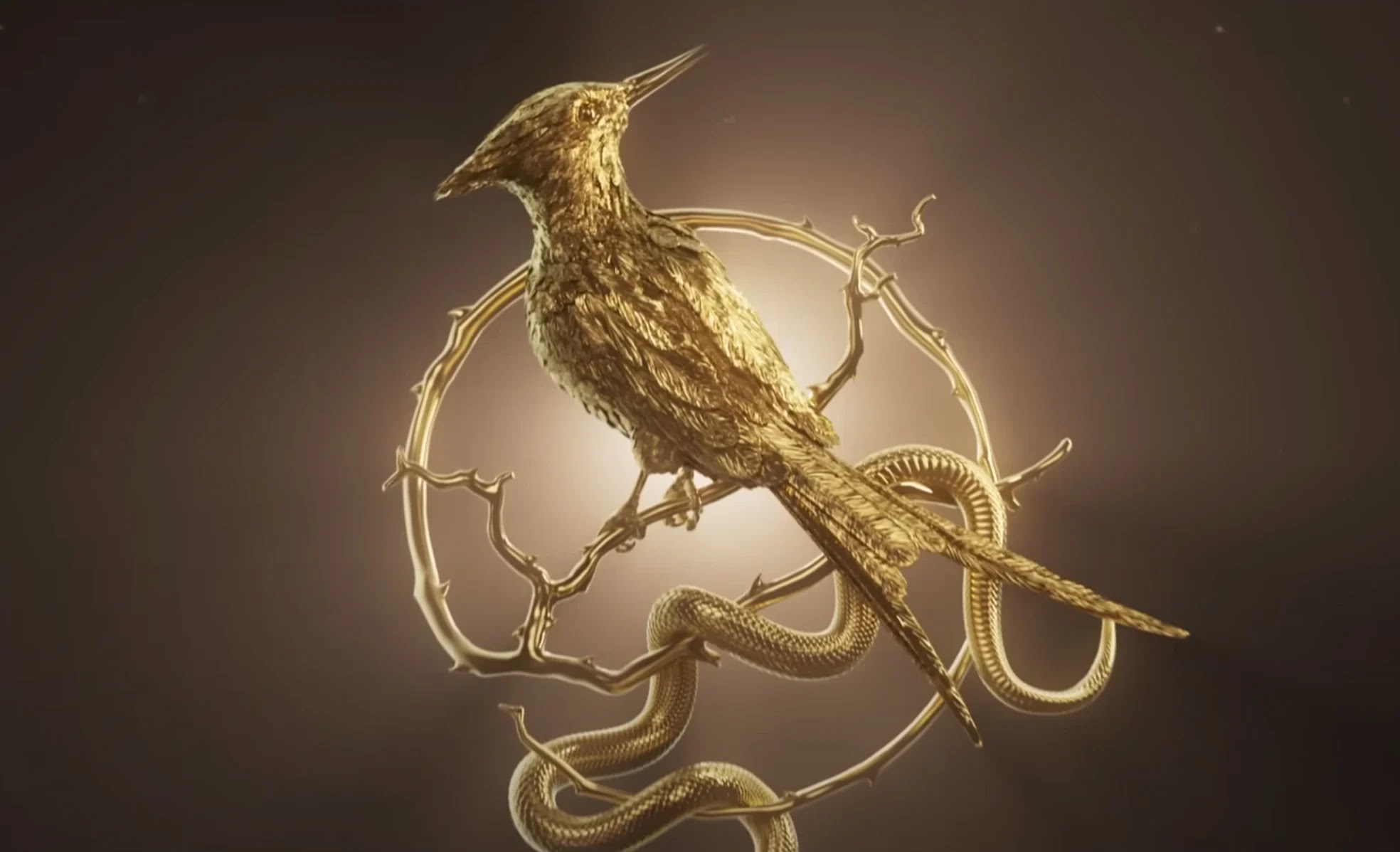
This year we’ll have the first Hunger Games movie in eight years. The new book, Ballad of Songbirds and Snakes, is set to have its movie released in November. Last year, I wrote about the story’s depiction of Coriolanus Snow and his descent into villainy. But before we see Coryo on the big screen, I wanted to spotlight one of the unique creatures of Panem: the mockingjay.


To refresh your memory, here’s a brief Panem history lesson. During the Rebellion, the Capitol started creating mutts for their war against the Districts. One of them was the jabberjay, which was capable of recording and repeating human speech. Kind of a covert reconnaissance drone to spy on the Districts. However, the Districts figured this out and used the jabberjays to feed false information.


When the Capitol realized the deception, the jabberjays were released into the wild to die off. But… They started mating with mockingbirds to create the mockingjay species. A slap in the face of the Capitol. While the mockingjay species couldn’t parrot human words like the daddy jabberjay (all jabberjays were male to avoid breeding… we see how well that worked out), the mockingjay could still copy tunes sung, whistled, or played. 


Chronologically, the first time we see the jabberjays and mockingjays is when Coryo was a peacekeeper in District 12. Even as a young adult, he hated the mockingjays, as they already represented a sense of rebellion towards the Capitol. He and the other recruits were tasked at times to hunt and kill the jabberjays and mockingjays, as a form of pest control and target practice. Some were sent back to the Capitol for study, but that was only a small sampling.


By the seventh decade after the Dark Days, the residents of District 11 used the mockingjays in their orchards to help signal the end of the work day. Rue, a tribute from the 74th Hunger Games, told Katniss that she would use a four-note tune to send word from the top of the trees down to let everyone know it was time to go home (much quicker that way). This trick also became a signal for Katniss and Rue during their time as allies to indicate safety. 


But before Katniss entered the arena for the 74th Hunger Games, she was given her famous mockingjay pin by Madge Undersee. This mockingjay pin became her token in the arena and it was the reason Rue decided to trust her and become allies. It was also the mockingjays who sang Rue to sleep as she died, after copying Katniss’s tune of “Deep in the Meadow."


After Katniss and Peeta won the 74th Hunger Games, the symbol of the mockingjay became fashionable in the Capitol. During their victory tour, Katniss saw it in jewelry, tattoos, and more. For Capitol citizens, they were just excited to wear the victor’s token. However, for the rebels it was a very different symbol. A symbol of rebellion. For example, Bonnie and Twill, who were found by Katniss outside District 12, had a flat piece of bread with the image of a mockingjay to demonstrate their allegiance.


When the Quarter Quell came around, bringing Katniss and Peeta back into the arena, Effie had the idea of matching tokens for their team. Ultimately, Peeta was given a medallion with the mockingjay as his token and Haymitch got a golden bangle. His bangle was ultimately given to Finnick to prove his allegiance to Katniss in the arena. 


After the abrupt ending of the Quarter Quell, District 13 and the rebels wanted to make Katniss their symbol, their mockingjay, to rally the districts together against the Capitol. Cinna even made Katniss’s wedding dress change into one like a mockingjay during her Quarter Quell interview. If that’s not a slap in President Snow’s face, I don’t know what is. But it paved the way for Katniss to inspire the districts into revolting and for the creation of a new Panem.


For now, I’ll close where I began, with Ballad of Songbirds and Snakes. Specifically, a quote from Lucy Gray: "The show is not over until the mockingjay sings."